Townandaround.org.uk
December 2019
An Unusual
Christmas
Card of
Historic
Importance
by D Gwynne Morris
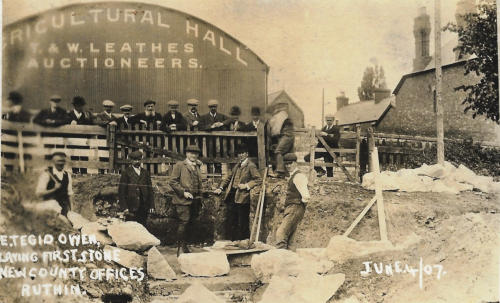
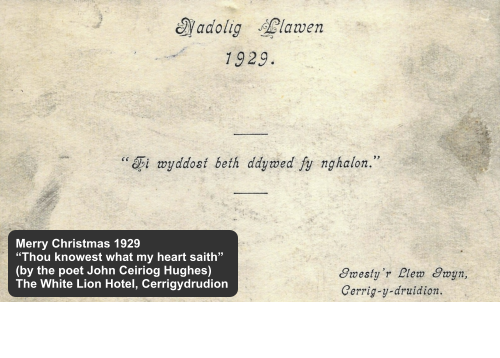
The Christmas card, dated 1929, is significant in that it is the only one known to have survived
showing the laying of the first foundation stone of the new building for the Denbighshire County
Offices just 110 years ago on land donated by the Ruthin Borough Council. It is also unusual to use
this sort of card for Christmas greetings!
At the time, this land directly opposite which was then the Agricultural Hall, now the town car park
and at the corner of Market Street and Wynnstay Road was tenanted by R. James Jones, a
stonemason and a local councillor.
The laying of the stone was carried out by Edward Roberts of Brymbo, the Chairman of the County
Council, in the presence of local dignitaries, on June 4th, 1907.
As shown by the note on the card, right, the photographer may have been E. Tegid Owen (or he
may have been in the ceremonial party). At the time, he was very well known in the area as the
owner of the prestigious ‘Castle Hotel’ on St Peter’s Square and a prominent Ruthin borough
councillor.
His had been a very successful business but owing to the then wartime troubles in 1919, things
were not going as well as he had hoped. He decided to sell and took over the White Lion in
Cerrigydrudion, (Gwesty’r Llew Gwyn on the back of the card, below, with Cerrig spelt Cerrig y
Druidion), where his wife had family connections.
On the completion of the building work, which had cost £6,500, the Denbighshire Free Press on
March 27th, 1909, under the heading “New County Offices, Ruthin” had this interesting account.
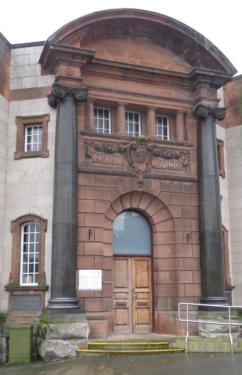
“The building is built of tooled local
limestone facings with dressings of
Runcorn stone. The main entrance is
flanked on either side by polished
emerald pearl granite columns 22ft
high, the steps of Idle (near Bradford)
stone and the roofs covered with
grey slates.”
“The local limestone mentioned was
from the Eyarth Quarry generously
placed at the disposal of the county
council by the Ruthin council.”
The account ends with the statement, “It may be of interest to our readers to know that the red stone
for ashlar dressings was obtained from the Runcorn quarries. The same stone is now being
obtained from for the Liverpool Cathedral.”
Another interesting piece of information appeared in the Free Press of
Saturday November 23rd, 1907, which stated that “… on Wednesday. The
men were placing, with the help of a crane, the massive pillars on the two
sides of the main entrance into position. The pillars are in sections, each
portion weighing about 2ton 18cwt. One portion had been safely hoisted at
the right hand side, and it was whilst holding another section aloft,
preparatory to fixing it on the other side of the entrance, that the crane
broke, with a resounding crash, the pillar section, together with the long arm
of the crane, fell.”
The same account stated that “Two stone tablets, with gilt inscriptions in
English and Welsh, were yesterday placed on either side of the main
entrance.”
How many of our readers have noticed them and how many know the
number of sections there are on each pillar?