Castle Hotel—a brief history
The splendidly refurbished Castle Hotel on St
Peter’s Square would be an adornment to any
town. It dominates the south side of the square
where its Georgian elegance sits at ease with
the surrounding older buildings. Here at
Ruthin’s former Market Place, for almost 600
years, twice weekly markets were held, driving
the town’s economy. In and around Market
Place, prime property sites housing storage
cellars, workshops and taverns developed.
The first buildings had mud walls with roofs of
branches covered with stones and primitive
thatch. Easily and quickly built, they equally
easily and quickly disappeared, leaving no
obvious traces.
Market Place attracted property speculators
such as Galfridus Clerk otherwise known as
Gruffydd ap Madog, whose daughter Luce vetch
Geoffrey owned the Castle Hotel site in 1465.
Around this time the first durable building was
erected—later described as three shops, a cellar
and a loft. The only building on the east side of
Market Place with an upper storey, it stands
taller than its neighbours in a 1715 drawing.
Parts of the ground floor shops and the cellars
survive in the present Castle Hotel, as do the
rear buildings.
No evidence for a tavern in Tudor times exists
but the owner in 1594 had a licence to sell wine.
The hotel appears at the Restoration as the
White Lion with William Walker as the owner
and he leased fields around Ruthin to supply
fresh milk, meat and vegetables for customers
and hay for horses. The hotel continued to grow
much of its own food until the end of the
nineteenth century. Walker was active in Ruthin
from the end of the civil war and like many of
his successors became an important figure in
the town.
During the 1670s the business struggled and
Walker had to sell the hotel in 1679 for £200 to
the Myddeltons who owned the Castle estate.
The seventeenth century White Lion had four
bedrooms on the upper floor and beds in the
garret and on the ground floor where reception
space could be converted into bed space, if
needed. The building survived until after 1746,
but with the growth in travel following road
improvements, the Myddeltons pulled down the
old White Lion front building and built today’s
fine Georgian structure. The White Lion
prospered and expanded taking in its
neighbours—all the property on the north for
new bedrooms and part of that on the south for
dining space.
The White Lion became the town’s leading hotel
and a magnet for the local gentry, tradesmen
and politicians, where elections were arranged
over convivial meals and social functions, cock-
fighting, licensing meetings and dinners were
held. A succession of successful
landlords,Povah, Roberts, Green and Owen,
added lustre to the reputation of the White Lion
and Green modernised the hotel in the 1870s.
Functions mushroomed: land sales, a posting
centre, a revenue office and a coaching hotel
were accommodated. It was the town’s main
point of arrival and if you could afford it the Lion
was where you stayed in Ruthin.
The nineteenth century brought fresh
challenges and opportunities The large
assembly room in the new town hall competed
for functions. The revival of Ruthin Castle
attracted wealthy visitors and business callers.
The train came, and customers were collected
from the station, and cars and buses followed.
From the 1870s, the hotel began to be known as
the Castle Hotel and by 1883 the “Whiate Lion”
had gone.
The last tenant landlord, Tegid Owen, bought
the hotel in 1913 for £1,200 and Owen sold out
in 1919. It was by then a large hotel with
reception rooms, 15 bedrooms and stabling for
at least 20 horses, as well as garaging. In 1933,
Trust House Group, who rescued coaching
hotels, bought it. They refurbished it as an
exclusive hotel and sold it in 1971; the hotel
continued to trade well attracting wedding
parties and clients to its excellent cuisine.
By 2003, the Castle Hotel was split from its
northern neighbour. Its fabric deteriorated
alongside declining visitors and it has been
rescued by Wetherspoon’s, who are in a
sense taking the hotel back to its origins as a
centre of hospitality. It has come full circle.
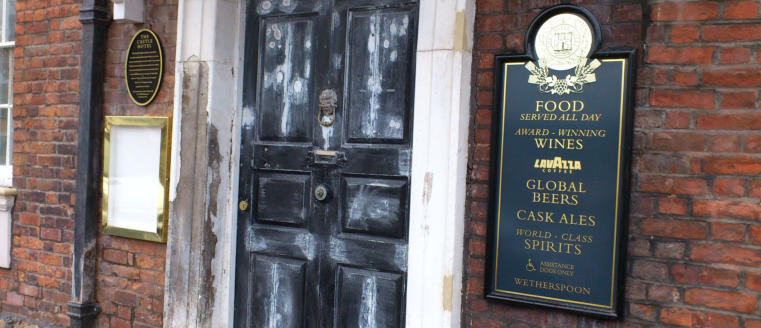
GARETH EVANS relates a fascinating tail, coinciding with the opening
of J D Wetherspoon’s Castle Hotel in January 2012

Town and Around Current Edition
Town and Around Historic Contents
Contact Us
Ruthin Local Historic Society
Copyright © 2018 Ruthin & District Civic Association


