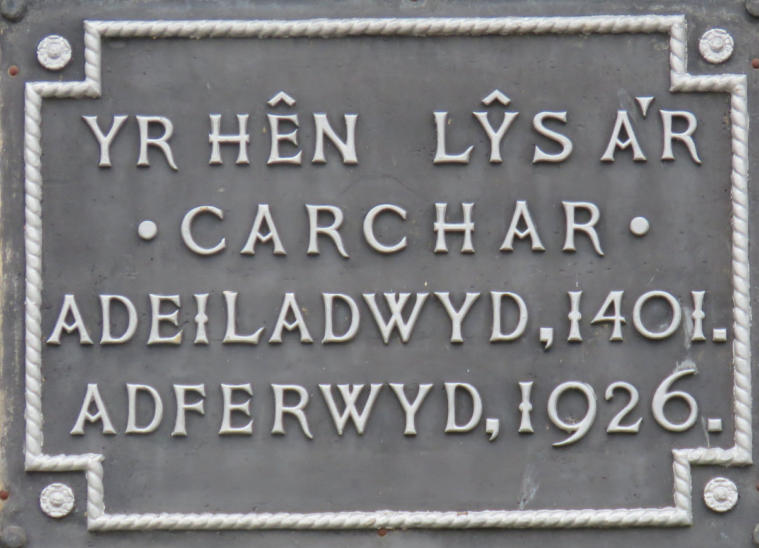
The Old Courthouse
The Courthouse of the lordship of Ruthin
symbolises the recovery of the lordship after
Owain Glyndŵr's revolt. Trees were felled in
1421 to build it. Four arches made of green
wood formed the sides of the new Courthouse
and supported the roof and remain in place
today.
The Royal Commission on Ancient Monuments
in Wales believed the original building consisted
of a central open hall set between two storeyed
end bays and the 1926 restoration reinstated
the original concept which we have today.
TUDOR AND STUART CHANGES
The sale of the lordship to the crown in 1507
changed its status and the ground floor
probably appeared after then and became
engulfed by shops in the sixteenth century.
By1579 fifteen shops were accommodated on
its ground floor. Further changes extended the
original building westwards by a bay in a
different style and three stumpy projections
were added to the south side, at least one with
a foundry.
The building was known by various names
including the 'Chequer chamber' but from the
early sixteenth century its most consistent
name was the Pendist. The courtroom was still
an important part of government machinery in
the mid seventeenth century until replaced by
the Shire Hall in 1663. The Pendist was the
scene of the execution of Father (now Saint)
Charles Meehan, an Irish Franciscan in 1679.
Convicted of being a Catholic priest, he was
hung, drawn and quartered. The remains of a
gibbet are on the north side near Castle Street.
During the Stuart period most of the small
shops on the ground floor merged into one
large shop.
GEORGIAN SHOPS
Ruthin's largest eighteenth century shop
developed in the Pendist. Shops replaced the
lordship court which was relocated and in the
1770; it was meeting in the town's tavems.
Throughout the century the owners of this shop
had close political and financial connections
with the Chirk Castle estate, acting for them and
supplying the estate with hardware and building
material. The shop was known as 'Old Hall and
was the largest in Ruthin and the southern Vale
of Clwyd's premier shop.
VICTORIAN IRONMONGERS
The Courthouse became exclusively a
commercial property and from at least 1827 was
mainly occupied by a grocery and ironmongery
business. From 1850, it was run by the same
family: first, Evan Jones until the mid-1870s
succeeded by his son, John Evan Jones and then
by his grandson, Herbert Evan Aldrich. For most
of this time their business was called Siop
Pendre. The former upper courtroom became
an auction mart which Herbert Aldrich took over
as a show room with his shop occupying the
four oldest bays and sometimes called 'Ye Olde
Courthouse', Goods for sale would be
impressively displayed outside creating a must-
visit experience for most visitors to Ruthin, like
today's Tesco. The bankruptcy of the Castle
Estate led to the sale of the Courthouse in 1913
and the age of the shopkeepers at the
Courthouse began to end.
BANK
There were only two tenants by 1913, and one
was replaced by the National Provincial Bank in
1914. The bank purchased the building outright
in 1923 for £2400. Aldrich's had left the building
by 1926 and the bank proceeded with what was
probably a much needed restoration.
The bank demolished the rear extensions
improving the rear view of the bank and the top
of Well Street. Centuries of adaptations to
provide commercial space were stripped away
and The Court House was restored reinstating
the central open hall set between two storeyed
end bays.
Aesthetically, the restored building is a triumph
closing the south of St Peter's Square and
complementing the Georgian Castle Hotel and
the reconstructed Exmewe Hall on either side. It
is one of the most photographed buildings in
Wales and rightly so. The bank saved the
building but has now plunged its future into
doubt. Let us hope a suitable use can be found.
In March 2017, GARETH EVANS looked back at one of our most
historic buildings
Adeiladwyd ym 1401? Neu ar ôl 1421?

Town and Around Current Edition
Town and Around Historic Contents
Contact Us
Ruthin Local Historic Society
Copyright © 2018 Ruthin & District Civic Association


