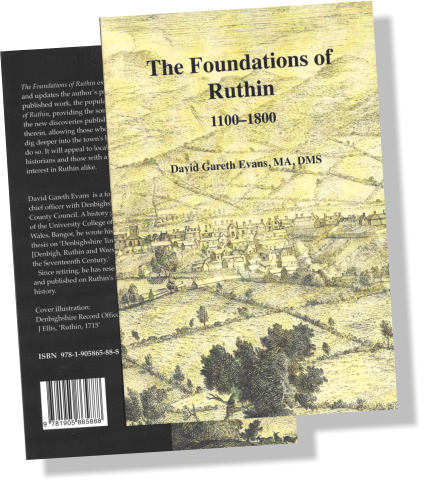
“The Foundations of Ruthin”
Before the book was even opened I was very
intrigued with its cover which I later discovered
was based on the first ever illustration of the
town by J. Ellis and entitled 'Ruthin, 1715'. Can
you find St. Peter's Church prior to the addition
of its steeple?
Over time, several learned articles by eminent
historians have been written on aspects of the
town's development. Other books/booklets
have been written on Ruthin’s past from William
Davis’s ‘Handbook for the Vale of Clwyd’ with its
‘Topographical and Historical Description of
the Town of Ruthin’ (and others)
through Rhuddenfab’s
‘Handbook to Ruthin
and Neighbourhood’.
Many of these are
based on recollections
and written material by
previous authors. The
most recent
authoritative 'History of
Ruthin' of whom the
author of Foundations of
Ruthin' was a major
contributor and co-editor
was based on written
historical evidence.
The main differences
between ‘The
Foundations of Ruthin’
and ‘History of Ruthin’ are
the inclusion of an evidence
base so that readers can see where the history
has been derived, the provision of an index so
that the knowledge is made more accessible
and the compilation of a time-line so that the
main events during the seven centuries covered
by the book are all available on just over two
pages. In addition, each of the six sections from
‘An Early Welsh Town’ to the very interesting and
authoritative ‘Georgian Ruthin’ has its own
'research notes. ‘Georgian Ruthin’ alone has
references of 477 Notes! Readers can now see
where the new facts in ‘History of Ruthin’ came
from and, if they wish, seek out the original
document and judge for themselves whether it
has been accurately dealt with.
Readers can also see the many publications,
which have included aspects of Ruthin’s history
especially in medieval times and which include
eminent scholars among their authors Eminent
Historians who are referred to include Sir Ifor
Williams, as far back as 1939 explained the
derivation of the name Ruthin—which is
contrary to the one often mentioned by other
writers. You will be left to decide. Another, an
eminent present day historian is extensively
quoted on his work is Dr Matthew Stevens of
Swansea on ‘Ethnicity, Gender and Economy in
Ruthin, 1282-1343’.
Fresh research has allowed the incorporation of
sections on an Elizabethan tavern the oldest
building description to survive in Ruthin from
1580; the first town hall dating from the early
years of the seventeenth century; Christmas
church services and most importantly the
North-nave roof of St Peter's where, in view of
its importance, a special
and very
comprehensive
appendix has been
provided.
The evidence base
also has additional
text which allows a
deeper knowledge of
some historical areas.
Principal among
these are the
boundaries of Little
Park, the massive
rise in parish rates
through the
eighteenth century,
Georgian poor relief,
an early eighteenth
century political
riot, eighteenth century travel
and eighteenth century shops,
including a detailed walk with the valuers
through Ruthin’s largest shop.
Adding illustrations usually enhance any book of
this nature. Due to the years covered by this
work they will naturally be very few available.
However we do have two very interesting ones-
both dated 1826. The first entitled ‘Medieval
Ruthin’ is an excellent one showing the east to
west configuration of the early settlement and
the second, showing more detail following the
‘Georgian Ruthin’ section certainly adds interest.
I venture to state that never before has there
been such a deep seated study of the roots of
Ruthin with such scholarly and readable detail,
which will not only educate those of us with an
interest in our locality but also to the more
professional historians nationwide. This short
review cannot possibly do the work justice-only
your reading of it will do that.
Dare I ask what the author will discover for the
post 1800 years and when will we see the follow
up?
In March 2017, GWYNNE MORRIS finds much to enjoy between
the velvet covers of a new book by Gareth Evans

Town and Around Current Edition
Town and Around Historic Contents
Contact Us
Ruthin Local Historic Society
Copyright © 2018 Ruthin & District Civic Association


