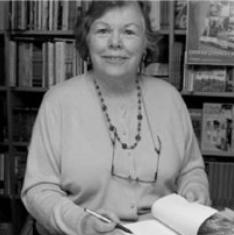
Hafina Clwyd 1936–2011
Teacher, writer, columnist, historian,
diarist, political animal, feminist,
above all a citizen, Hafina Clwyd
Coppack who died in March, will be
greatly missed by all those who
knew her, read her works, and were
inspired by her passionate
commitment towards language and
culture, and, not least, to Ruthin,
her home territory.
A farmer’s daughter, she was born in
Gwyddelwern, grew up in Llanychan, and was
educated at Bala Girls’ Grammar School.
She trained to be a teacher at Bangor Coleg
Normal, and taught in London from 1957 until
returning to Wales in 1979. It is easy to lose
contact with your roots in the vastness and
anonymity of Greater London, and many do so.
Not Hafina. She threw herself into the life of the
London Welsh, taking a leading role in the
formation of Clwb Llyfrau Cymraeg (later, the
Welsh Books Council), and organisation
described by Meic Stephens, in his obituary for
Hafina in the Independent, as ‘the ancient and
most pinstripe of all Welsh expatriate societies
in London’.
Back in Wales with her husband Cliff Coppack,
Hafina soon estabIished herseIf as a
commentator on Welsh affairs, writing regular
columns for the Western Mail, and, in Ruthin for
Y Bedol and, Y Faner, and, not least, as I am sure
she would have agreed, for Town and Around.
She was a prolific novelist and storyteller, and
had a voracious interest in family history—her
own, and that of countless other families, whose
researches she encouraged. Her Pobol sy Cyfn
(It’s People who Count), a deep analysis of the
the 1891 census, was agreed on all sides to be a
most valuable contribution to the social history
of a rural area. Those who want I to read more
of her output neec only consult
the Transactions of the
Denbighshire Historical Society
in Ruthin Library.
It was perhaps typical of Hafina
that it was politics which
brought her to active
membership of the Ruthin and
District Civic Association. She
attended the first of our now
familiar Hustings before a
general election, was impressed; and came to
me afterwards to see if she could join. It was of
course an honour to have her or board. She was
soon on the committee, involving herself with
Arnold Hughes and myself in the choice of sites
for the green plaques commemorating people
and events in the history of Ruthin, which are
now such a familiar feature of the town. There
would be a strong case for installing a plaque to
honour her - certainly there should be some
kind of visible recognition of her many
achievements and contributions to Welsh and
local life, including of course, her membership
of the town council, her year as mayor of Ruthin
(of which she was immenseIy proud), her
unstnting support for the Craft Centre, and her
honorary fellowship of Bangor University, her
alma mater.
Of course, for those of us on Town and Around,
it was her membership of the editorial group
which was particularly special. As editor, I
valued first the quality of her writing and the
range of her interests and contacts. But she also
knew, from nay years experience, the kind of
pressures which all editors face; she never
missed a deadline and insisted that the editor
had the last word—in that, if no other respect,
she was not a democrat!
Derek Jones

Town and Around Current Edition
Town and Around Historic Contents
Contact Us
Ruthin Local Historic Society
Copyright © 2018 Ruthin & District Civic Association


