Memorial to Fallen Heroes
It does not make for pleasant reading when one realises how long it took for the Memorial in
Wynnstay Road to be erected and blessed. What follows here his is only a part of the story but I hope
it will give the reader a glimpse of the history behind its long delayed installation.
This short article will only be part of a very lengthy journey. The war ended
on the eleventh hour of the eleventh month of 1918. 16 days later, on the
November 27th, a letter was read to Ruthin Town Council from Mrs
Cornwallis West of Ruthin Castle, offering to erect at her own expense a
shrine to the memory of Ruthin’s fallen soldiers. The Council gratefully
accepted and thanked Mrs West for her generous offer but no subsequent
mention of this ever appeared. The movement thus initiated took seven
years to bring to fruition.
Ruthin Town Council met on January 8th, 1919, with the Mayor (Councillor W.
Godfrey Lecomber, whose youngest son Philip had been killed on March
27th, 1918 and had been recommended for the Victoria Cross) presiding.
When the matter of a memorial was raised, Councillor W H Williams
suggested that they consider the erection of a new Town Hall—he considered
the present building to be too small, holding only about 400 people, whereas neighbouring towns
possessed halls seating 1,500! Other ideas, such as that put forward by Councillor James Jones who
advocated the purchase of a field known as “The Bull Croft” to be laid out ornamentally. This field was
behind the County Offices in Market Street. He envisaged this as an attraction to visitors, with bowling
greens, croquet and tennis courts. The suggestion was well received and the Council appointed a
committee to consider whether to provide a memorial and the form it should take.
A poorly attended public meeting was held on February 6th, 1919, when Mr J C Davies, then the
Director of Education, wanted a memorial to promote the health of the people. There was evidence of
deterioration in people’s conditions, doubtless due to the war, and he supported the Mayor’s
suggestion that swimming baths should be provided. Many disagreed and said that as Ruthin was not
industrialised, baths were not needed. A new Town Hall with a museum and reading room would be
better.
Mrs Springman, however, pointed out
that the hospital, which belonged to the
Ruthin Union and which had been used
by the Red Cross during the war, was
about to be closed. This should be
purchased and made into a Free
Hospital under the management of
three local doctors.
Mr Ellis Williams, a hairdresser who had
himself served in the war and was now
a Councillor, emerged as a spokesman
for the ex-servicemen. Many felt that a
memorial should be erected on the
Square, behind the Peers Memorial clock tower where it would serve as a constant reminder. Another
suggestion was that a tree for every soldier should be planted on the streets. Also, surviving soldiers
should be granted the Freedom of the Borough. Others suggested the restoration of the Moel
Fammau Tower and the renovation of the Llanrhydd Almshouses.
This seemed to be the end of the matter. No more progress was made for the next TWO YEARS! In
March 1921, a petition was received by the Council expressing the concern of the townspeople at the
lack of progress and that the matter of the memorial had been dropped. Even then, it was not until
the following year, in April 1922, that another public meeting was convened.
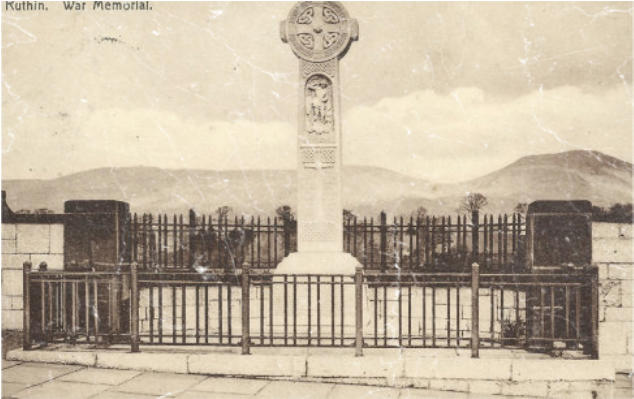
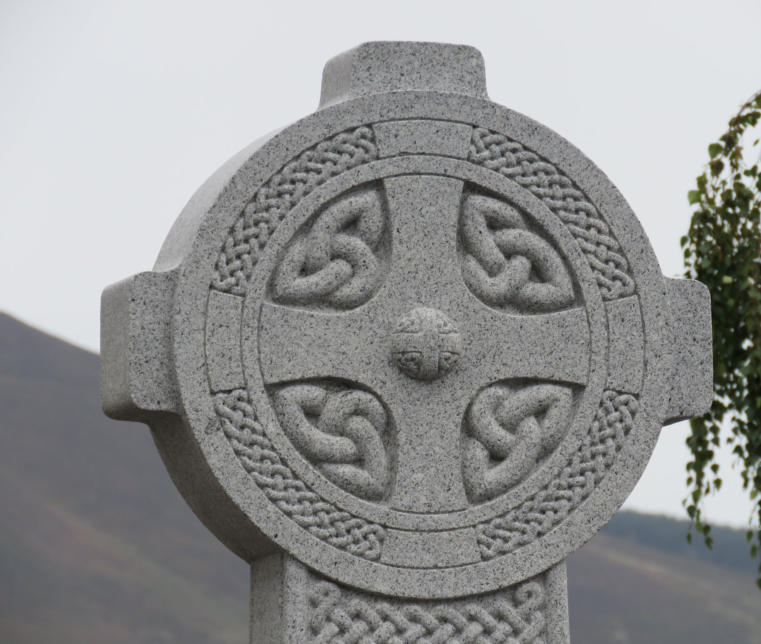
At that meeting it was disclosed that a Mr Harold Hughes, the Bangor Diocesan architect, an authority
on Celtic crosses, had prepared plans for a monument to be erected in “New Street” [Wynnstay Road]
which would be viewed against the Clwydian range as a backdrop.
Many approved, but the majority wanted it on the Square, a choice strongly advocated by Councillor
Ellis Williams and the ex-servicemen. The main reasons against were that it would be dwarfed by the
St. Peter’s Church spire and the Peers Memorial clock, which would have to be removed. The
traditional fairs and markets would not be appropriate neighbours, whereas the quiet dignity of
Wynnstay Road would be ideal. The meeting adjourned for a week.
At the resumed meeting Mr Meiric Roberts, a local tailor, tradesman, councillor and ex-serviceman,
proposed a compromise that Mrs Williams of Crown House be approached regarding the purchase of
the Bull Croft. She had declined to do this on a previous occasion and she declined again. Meanwhile,
other parts of the Square were considered, such as an area of land in front of the ‘Old Court House’.
The bank was approached by letter on July 28th, 1923. There was no reply until April 28th, 1924 when
“…we much regret we do not see our way clear to accede to your request to place the Memorial in
front of our premises known as Ye Olde Court House.”
Councillor Ellis Williams now proposed that, as public meetings had been unsuccessful, the Council
should now assume responsibility. In May 1924, it was decided to proceed with the erection of a
memorial on the site between the County offices and the Presbyterian Church On Wynnstay Road on
the land donated by the County Council for the purpose. It was also put forward that the plans
previously drawn by Mr Harold Hughes, the Bangor Diocesan architect, be agreed upon.
The monument took the form of a column in Aberdeen Grey Granite which was supplied by Messers
Garden & Co. from the Granite Works in Aberdeen—the Granite City. the Denbighshire Free Press of
October 1925 stated that this granite portion of the war memorial had arrived at the yard of the
contractor, who was now the Mayor, Alderman R J Jones, a monumental mason. The pedestal of the
monument which contained the names of the fallen soldiers from Ruthin was already in place. It also
stated that it was hoped that the complete memorial would be ready for the unveiling ceremony on
Armistice Day.
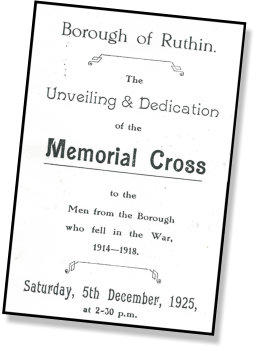
Unfortunately, this was not to be. It was eventually unveiled and dedicated on
December 5th, 1925, seven years after the end of the war, in a ceremony
performed by Lord Kenyon, the County’s Lord Lieutenant.
Second World War
It took seven years after the First World War before the memorial in Wynnstay
Road was erected and commemorated. It took NINE YEARS after the Second
World War before final agreement was reached to retain it on its present site!
What on earth went on...and why so long?
The first mention of such a memorial was at a meeting of the Finance & General
Purposes Committee of the Ruthin Borough Council took place on June 23rd, 1947. It was reported
that it “was two years since the War ended and that it was advisable that the names of the fallen
should now be ascribed on the War Memorial”. What did they do? They resolved that the matter be
referred to a Sub-committee comprising the mayor with councillors Meiric Roberts and Oswald
Thomas, together with the architect Mr S. Colwyn Foulkes. It was not until January 24th, 1949 that he
replied requesting the number of names to be added. As a result, the local branch of the British
Legion were contacted.
Now came the biter bit. The Legion was not happy with the Memorial in Wynnstay Road and
requested that it be removed and re-erected in Crispin Yard off Clwyd Street. To this suggestion the
council agreed and the borough surveyor was instructed to prepare the plans. At the same time it was
resolved that the county planning officer be contacted for his views.
At a meeting on December 5th, 1949, he informed the council that he was not in favour, turned down
the idea and suggested instead that the memorial be erected on the disused burial ground at St.
Peter’s Church. At the time the site was occupied by a derelict house opposite the side of the Post
Office. The clearance of the site would require not only the removal of the house but also the removal
of nineteen gravestones and a change in the direction of the diagonal path skirting the church. The
council agreed with this and at the end of October 1950 they approached the secretary of the
Representative Body of the Church in Wales and requested an early reply.
A reply was received which seemed to be in favour but no further developments went ahead.
However, when a reply was received from the Chancellor of the Diocese—a Mr Harold Edwards—it
was clear that he did not agree with the plans. By now, the members of various ex-service
organisations were getting very upset at the time it was taking to resolve the matter and at a special
meeting of the council on September 19th, 1953, nine members voted for and five against that the
war memorial should remain at its present site.
In the November of that year, when Alderman Roberta Beech was mayor, things moved forward and
that they should agree with plans put forward by the borough surveyor. These were that the rear wall
be taken down to its foundations and re-built in red stone to the same height as the flanking pillars
and that the railings in the rear wall would not be re-built.
It was also suggested that three plaques be inserted in the new wall, one slightly less in size than the
other two placed in the central rear, recording the 1939-1945 war and flanked, one on each side, by
the remaining plaques each with the names of the fallen recorded upon it. The plaques were to be of
grey granite similar to the existing Celtic cross. To this they all agreed and that an appeal would be
launched to raise funds for carrying out the work.
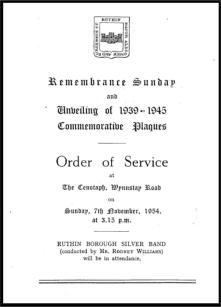
Tenders were put out and the work was given to Messrs Norman Hughes & Co Ltd, Ruthin, for the
total sum of £422 15s 9d. It as finally completed in time for the Remembrance Service on Sunday
November 7th,1954.
Since then other major additional names have been added from that war and other conflicts since.
At the centenary of the end of the First World War, it is only right to look back on
how our forebears in Ruthin went about remembering those who had fallen in the
line of duty, wrote D GWYNNE MORRIS in June & September 2018

Town and Around Current Edition
Town and Around Historic Contents
Contact Us
Ruthin Local Historic Society
Copyright © 2018 Ruthin & District Civic Association


