The Dramatic Collapse of the North Wall
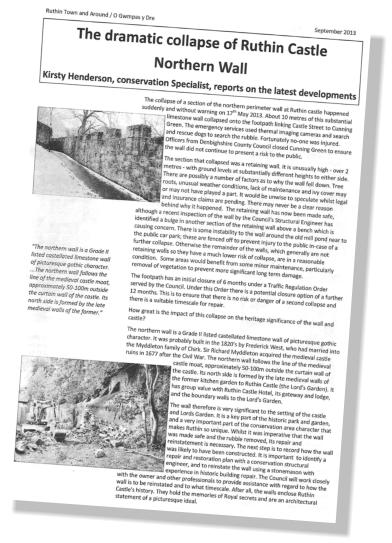
The collpas eof a section of the norther
perimietr wall at Ruthin Castle happened
suddenley and without warning on May 17th,
2013. About 30 ft of this substantial limestone
wall collapsed onto the footpath linking Castle
Street to Cunning Green. The emergency
services used thermal imaging cameras and
search and rescue dogs to search the rubble.
Fortunately no-one was injured. Officers from
Denbighshire County Council closed Cunning
Green to ensure the wall did not continue to
present a risk to the
public.
The section that collapsed
was a retaining wall. It is
unusually high - over 2
metres - with ground
levels at substantially
different heights to either
side. There are possibly a
number of factors as to
why the wall fell down.
Tree roots, unusual
weather conditions, lack
of maintenance and ivy
cover may or may not
have played a part. It
would be unwise to
speculate whilst legal and
insurance claims are
pending. There may never
be a clear reason behind
why it happened. The
retaining wall has now
been made safe, although
a recent inspection of the
wall by the Council’s
structural engineer has identified a bulge in
another section of the retaining wall above a
bench which is causing concern. There is some
instability to the wall around the old mill pond
near to the public car park; these are fenced off
to prevent injury to the public in-case of a
further collapse. Otherwise the remainder of
the walls, which generally are not retaining walls
so they have a much lower risk of collapse, are
in a reasonable condition. Some areas would
benefit from some minor maintenance,
particularly removal of vegetation to prevent
more significant long term damage.
The footpath has an initial closure of 6 months
under a traffic regulation order served by the
Council. Under this Order there is a potential
closure option of a further 12 months. This is to
ensure that there is no risk or danger of a
second collapse and there is a suitable time-
scale for repair.
How great is the impact of this collapse on the
heritage significance of the wall and castle? The
northern wall is a Grade II listed castellated
limestone wall of picturesque gothic character.
It was probably built in the 1820s by Frederick
West, who had married into the Myddleton
family of Chirk. Sir Richard Myddleton acquired
the medieval castle
ruins in 1677 after
the Civil War. The
northern wall follows
the line of the
mediaeval castle
moat, approximately
50-100 yards outside
the curtain wall of
the castle. Its north
side is formed by the
late medieval walls of
the former kitchen
garden to Ruthin
Castle (the Lord's
Garden). It has group
value with Ruthin
Castle Hotel, its
gateway and lodge,
and the boundary
walls to the Lord’s
Garden.
The wall therefore is
very significant to the
setting of the castle
and Lords Garden. It
is a key part of the historic park and garden, and
a very important part of the conservation area
character that makes Ruthin so unique. While it
was imperative that the wall was made safe and
the rubble removed, its repair and
reinstatement is necessary. The next step is to
record how the wall was likely to have been
constructed. It is important to identify a repair
and restoration plan with a conservation
structural engineer, and to reinstate the wall
using a stonemason with experience in historic
building repair. The Council will work closely
with the owner and other professionals to
provide assistance with regard to how the wall is
to be reinstated and to what timescale. After all,
the walls enclose Ruthin Castle's history. They
hold the memories of Royal secrets and are an
architectural statement of a picturesque idyll.
In September 2013, specialist conservationist KIRSTY HENDERSON,
reported on the latest developments at Ruthin Castle

Town and Around Current Edition
Town and Around Historic Contents
Contact Us
Ruthin Local Historic Society
Copyright © 2018 Ruthin & District Civic Association


