William’s Friend
Described in December 2011, John Idris Jones told of the poet laureate
William Wordsworth’s visit to Ruthin
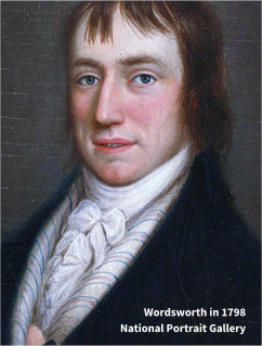
Throughout his life (1770-1850), William Wordsworth
held this man in high esteem. He was his friend at
Cambridge; they took a 3,000 mile journey through
France and Switzerland together
in 1790 and, for the rest of his
life, he kept in touch, through
visits and letters. In January,
1825, he wrote “… a most
affectionate Man and verily
believe the best tempered
Creature imaginable to me, who
am apt to be irritable at
travelling, an inestimable
qualification…” (Letters; ed. De
Selincourt; Oxford U.P., p297).
His friend was Robert Jones, of
Llangynhafal, Ruthin. His
prefatory address to the reader
and the following extract from
his poem “Descriptive Sketches” avows this:
Tonight my friend within this humble cot
Be scorn and fear and hope alike forgot
In timely sleep, and when at break of day
With a light heart our course we shall renew.
On the top road between Llanbedr D.C. and
Llangynhafal, a minor road turns up towards the hills;
on it is the only church dedicated to St. Cynhafal, on a
site dating back to the 7th century. Next to it is a
handsome black-and-white property with Tudor
chimneys. This is Plas yn Llan, where Wordsworth
spent some four months of his life. He was here in
1791, 1793 and 1824.
During his continental tour, Wordsworth had
enthused about the new events in the French
Revolution:
Jones! As from Calais southwards you and I
Went pacing side by side, this public Way
Streamed with the pomp of too-credulous day
When faith was pledged to new-born liberty.
In 1791, Wordsworth was in London. Jones wrote to
him in May inviting him to Plas yn Llan. He travelled
up and stayed until the third week in September. His
sister Dorothy wrote in a letter, “… my brother… is
now in Wales where he intends making a pedestrian
tour along with his old friend and
companion Jones at whose house he is
at present staying”. On June 26, Dorothy
wrote, “My brother William who is now
in Wales where think he seems so happy
that it is probable he will remain there
all the summer or the greater part of it.
Who would not be happy enjoying the
company of three young ladies in the
Vale of Clwyd and without a rival? His
friend Jones is a charming young man
and has five sisters, three of whom are
at home at present and then there are
mountains, rivers, woods, and rocks,
whose charms would be sufficient to
tempt William to continue amongst
them as long as possible...”
In later 1792, the poet returned from France, in a
distressed state over the vicious turn of the Revolution
and over his relationship with Annette Valon. In
August 1793 he travelled from Bristol, up the Wye, to
Tintern Abbey. He was with the Jones family in Plas yn
Llan in September. His sister writes that “He is now
quietly sitting down in the Vale of Clwyd. He is staying
with his friend Jones… and passes his time as happily
as he could desire; exactly according to his taste... He
says that their house is ‘quite a
cottage just such a one that would suit us’ and oh!
how sweetly situated in the most delicious of all vales,
the Vale of Clwyd.” (de Selincourt; p 105).
In 1824, the poet came to Wales again, this time with
his wife and daughter. He says that “Rev R. Jones
arrived and in his can we all proceeded to the Falls of
Conwy… Next morning we [visited] the ‘Valley of
Meditation’ (Glyn Mafyr) (sic) where Mr Jones has a
curacy. We called upon the celebrated recluses [in
Llangollen] and next day I sent them a sonnet from
Ruthin. We passed three days in the Vale of Clwyd.”
Robert Jones, who was for Wordsworth “the best of
companions, and a most affectionate man died,
according to the tablet on the wall of Llangwyfan
church, on April 4, 1835.

Town and Around Current Edition
Town and Around Historic Contents
Contact Us
Ruthin Local Historic Society
Copyright © 2018 Ruthin & District Civic Association


