1

Town & Around
O Gwmpas y Dre
Autumn 2026
News, Comment & Features from the Ruthin & District Civic Association since 2003




1
by Heather Williams
Founded in 1284 then re-established by
Gabriel Goodman in 1574 and relocated
to the Mold Road site in 1893, the
announcement of the sudden closure of
Ruthin School with it going into
administration at the end of the summer
school term was unexpected by many.
Only on June 27th the school was
promoting on social media that the
school had a small number of places still
available in September for the sixth form
and private tours could be booked.
In April 2023, the Daily Post reported
that the school was seeking investors. At
that time Nicholas Grenfell-Marten, the
school’s bursar, said if the sale was
possible they had been reassured that
there would be ‘no impact’ on its
operation. It was stated that the school’s
most recent published accounts from
August 2020 and the auditor’s report
warned of a ‘material uncertainty which
may cast significant doubt over the going
concern position of the school’. In
addition, the end of charitable status for
many independent schools and the
removal of VAT and business tax
exemptions could force up school fees,
prompting an exodus of students from
private education.
The negotiation for investors was
successful and Ruthin School was
acquired by a Chinese business woman,
who led the takeover, forming a
company Ruthin Educational Ltd (with
Nicholas Grenfell-Marten acting as the
company secretary). This was
subsequently linked to Galaxy Global
Education Ltd, which had other UK
schools under its control which took over
the school’s operation.
The appointed administrators are
Simon Farr and Philip Watkins of FRP
Advisory Trading Ltd. Darren Miller AS
has met with Simon Farr who gave his
explanation of the reasons behind the
closure of the school:
■ Pupil recruitment had been challenging
in recent years and numbers were
forecast to fall sharply at the start of the
academic year 2026/7.
■ At this stage there is no indication of
any asset stripping ‘at this stage’
End of Historic Era for Ruthin
Abbeyfield 2026: another era ends
Continued on p2
................................................................………………………………………………………….……………..
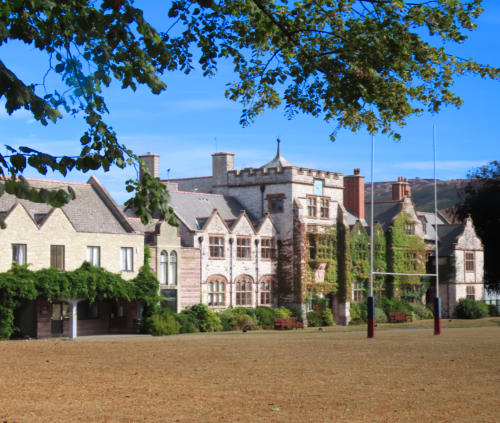
The main part of Ruthin School dates from the
19th century but even the more modern
extensions to the left are impressive
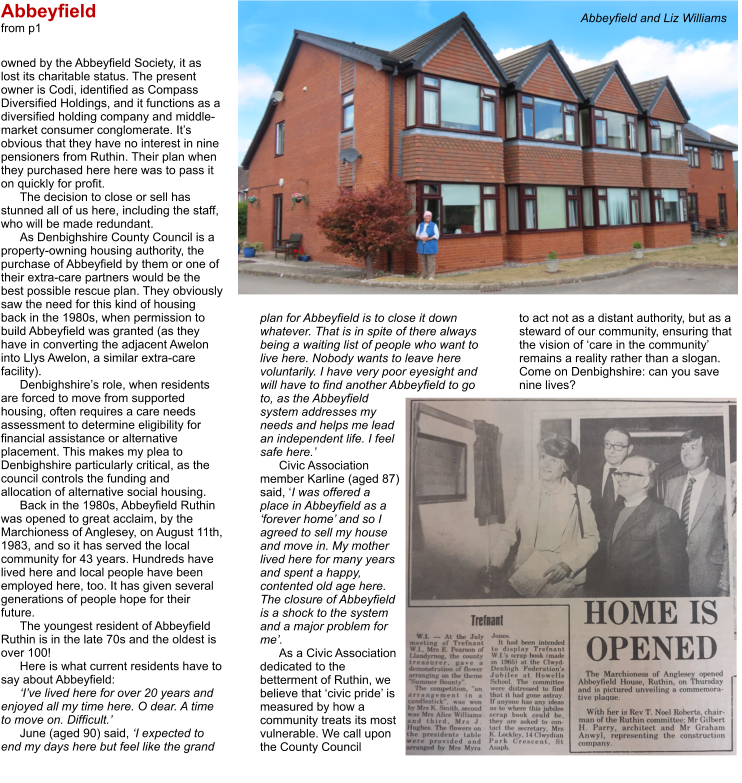
A tale of nine lives by
Abbeyfield resident
Liz Williams
The role of the Civic Association is to
champion the interests of all residents
and preserve the spirit of our town. The
potential loss of Abbeyfield is not just a
housing issue. It’s a civic issue. When we
lose spaces that foster companionship
and keep our older people rooted in their
own community, we lose a piece of the
town’s heart.
Abbeyfield is a scheme to bring lonely
people together, in an ordinary house, in
an ordinary street, getting support and
creating an atmosphere of
companionship from neighbours. It
fosters staying in the community in later
life, rather than moving away from it.
This in 1955 was the vision (today,
you would say ‘mission statement’) of
Richard Carr-Gomm when he left his
post as army major and started the
Abbeyfield Society. This concept
continues to be the foundation for all the
work done to alleviate the problems of
loneliness and isolation in Ruthin today.
The able managers and staff here
continue in this much valued tradition.
As a resident of Abbeyfield Ruthin, it
is with a heavy heart I report the intended
closure or sale of our home.
As Abbeyfield Ruthin is no longer
Continued on p3
2
2
I love Ruthin because it just feels like a
place with a bit of soul to it.
There’s something really nice about
living in a town where the past is never
far away. When you walk through
Ruthin, you can really feel the history:
the old buildings, the Castle, the
winding streets, and all the character
that’s built up over generations. It’s not
trying to be something it’s not. It’s just
proudly itself, and that’s a big part of the
charm.
But, for me, Ruthin isn’t just about
history. It’s more about the feeling of the
place.
It’s how the town shifts with the
seasons. Those crisp mornings when
the hills feel closer, summer evenings
when everything feels alive, autumn
when the Vale turns all those colours,
and winter days when everything goes
quiet and almost timeless. Living here
means having proper countryside right
on your doorstep, but still having a real
town at the centre of everyday life.
I love the views, too. Ruthin sits in
such a beautiful part of North Wales,
surrounded by hills, fields, and huge
skies. You don’t have to go far at all to
find a spot that makes you stop and
take it in. It’s easy to forget just how
much space there is here until you’ve
been away for a while.
But most of all, I love Ruthin
because of the people.
A town is just bricks and roads and
buildings without the people who bring it
to life. Ruthin has that real community
feel: familiar faces, local stories,
independent shops, and people who
genuinely care about where they live.
You can walk through town and feel like
you’re somewhere that actually matters
to people.
So when Ruthin School closed so
suddenly, it didn’t just feel like news. It
felt like a crack in something familiar. A
place that had held routines,
friendships, history and above all
futures, now gone in a moment. Just
like Abbeyfield, in fact.
Even so, Ruthin has been through
hard times before. The kind of hardship
that leaves a mark but doesn’t manage
to break the place. It doesn’t just
endure. Ruthin adapts and then it grows
into something new.
Ruthin isn’t perfect, and I don’t love
it because it is. I love it because it’s real.
It’s got its quirks, its challenges, and its
imperfections, just like anywhere else.
But that’s all part of what makes it
home.
There are places that are more
famous, more exciting, or more
impressive. But home isn’t really about
that.
Sometimes home is just the place
where you know the streets, recognise
the views, remember the moments, and
feel like you belong.
For me, that’s Ruthin. And that’s why
I love it.
From the Chair

................................................................……………………………………….……………………..............
including sales of land or buildings at the
school by its owner. However the
administrators will undertake further
investigations in line with their legal
duties. ‘At this stage’ hedges the issue.
■ The school has incurred losses
between £2-£2½m p.a. in recent years
■ The owners have invested in excess of
£6m to keep the school operating. This
would tend to suggest that the owners’
motives were not to strip assets.
■ A redundancy exercise was
undertaken in an attempt to make the
school financially viable.
■ The school was forecasting a loss of
around £1.2m in the next financial year.
■ The impact of the introduction of VAT
on fees, the loss of charitable status and
increase in employer’s national
insurance was estimated to be £1m p.a.
It supports a view that the school was
already in a perilous position before the
shock announcement. (N.B. in 2024/25
the school absorbed the 20 per cent VAT
rather than passing it on to parents).
Becky Gittins, the local MP has also
been active and has also been meeting
with the Administrators and an update in
mid- to late-August was expected to give
clarity to the situation for staff and others
affected.
Its closure will affect employment of
staff, local businesses/shops, school
suppliers and hospitality providers, and
also cause uncertainty as to the future of
land and a significant number of
buildings, some of which are listed.
At the present time some staff have
been kept on to deal with administrative
issues and the maintenance of the site.
Denbigh’s Myddelton College has
appointed the former head, Frances
King, and some staff members, and
some pupils are transferring to the
school in September.
Discussions are taking place with
North East Wales Archives to ensure that
valuable historic assets will be retained.
More details about the history of the
school can be found on the Old
Ruthinian Association website under the
History of Ruthin School section
www.ruthinora.co.uk/history-ruthin-
school.php
Some security measures are
in place now to ensure that the
main school building is
maintained, as so-called ‘urban
explorers’ soon took the
opportunity to film inside of the
property. It will be a challenging
job given the size and mixture of
property to make sure the
buildings and the land do not
deteriorate, and that a suitable
use can be found for them sooner
rather than later.
Ruthin School
from p1
It is right and proper that the initial
reaction should be focus on the plight
of employees and the impact on
pupils, adds Peter Daniels.
But now that we are at least partly
used to the change, what of the site
and the buildings?
The core of the school is grade II-
listed. Exactly one year ago, Town
and Around published an article on
the impact of the architect John
Douglas, including the original 19th
century school building. What will
befall that building? Will it remain
unused and deteriorating, just like
some of our redundant primary
schools?
Then there are other more
bespoke buildings, such as a sports
hall and a new restaurant. There are
also dormitories on site. One is a
much-altered Heulfre, not listed but
nevertheless with some architectural
and historic worth.
‘Goodman’, the former Anchor Inn
in town, was effectively saved by the
school in 2004. Its future at an
important gateway location now
seems uncertain.
There’s plenty of land. There are
said to be covenants on some of it to
protect the land for educational
purposes. We’d hazard a guess,
though, that at least part of the site
will terminate as housing.
As we say elsewhere regarding
the Quayle award winner, you never
know what could happen (see p12).
What might happen
to the site?

Rear of Ruthin School
3
3
Free Press, August 17th, 1983
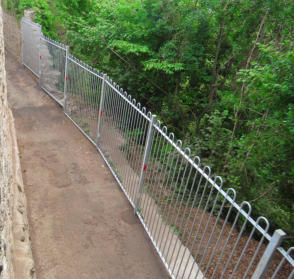
The Civic Association welcomes the
fencing now installed at the gap in the
previously fallen wall belonging to the
Ruthin Castle Hotel. Serendipitously, it
allows a view of the Castle and walls.
That the County Council has swept its
length and cleared growth is an
encouraging sign. Will all this activity at
last mark the reopening of Cunning Green
footpath?
That depends on the state of the
remainder of the wall. One thing’s for
certain: the County Council will not reopen
the path till they are absolutely certain of
the structural integrity of the rest of the
wall.
The County Council is responsible for
the path, not the structures that abut it.
These are in private hands,
except for the Lord’s Garden
wall (which previously collapsed
but was repaired as promptly as
possible by the County Council).
The fact that the fencing is in
place now really puts pressure
on the County Council and we
would again urge them to act
swiftly. Too much time has
already elapsed.
However, we should not be
surprised if in the near future
there is a further closure. The
state of the remainder of the
wall remains uncertain and with
autumnal stormy weather there
can be no certainty.
Cunning Development
................................................................……………………………………….…………………….......….......
A cleared and swept path with new
fencing on the Castle side
4
4
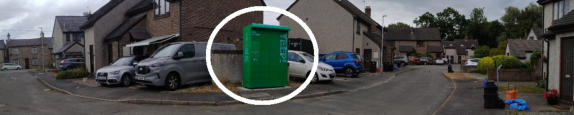
Tucked away Maes Ffynnon off Mwrog
Street may not be a heritage location
(other than the site of a former mineral
water works, of course). But does the
small housing estate justify an intrusive
bank of postal lockers? They appeared in
the last week of July.
The really scary thing here is that if
Maes Ffynnon can suddenly see such
infrastructure, presumably so could any
housing estate. Not just that, they could
potentially begin to threaten heritage
locations. Imagine one to the front or
side of the post office on St Peter’s
Square, for example.
The site in Maes Ffynnon is clearly
inappropriate and ill-judged. There are
better locations with lockers. And, five
minutes walk away at Bridge Services,
you can deposit and collect parcels
between 6 a.m. and 11 p.m. over the
counter.
As the residents of Maes Ffynnon
brace themselves for additional traffic
noise and nuisance at all hours, at
almost exactly the same time there
appeared lockers to the rear of County
Hall. That seems a more sensible
location. No neighbours, shielded from
the town’s heritage street-scene, and a
large car park. Those at County Hall had
planning permission. Not so at Maes
Ffynnon.
We struggle to understand why Maes
Ffynnon might be singled out in the eyes
of the locker operator. Could it be an
unusually high theft rate in
the general area, perhaps?
Meanwhile, as people
wonder why the range of
shops in the town centre is
diminishing, here’s the
answer. There are now
seven locker sites in Ruthin
from which to chose, plus
three shops taking in and giving out
parcels. All to cater for ever-growing
internet shopping demand.
■ The UK parcel locker market
transformed from a niche offering with
fewer than 2,000 locations in 2015 to
mainstream infrastructure (10,000+
locations by 2025). Plus 6,000 in store
collection points. Growth has been non-
linear and accelerating, with the sharpest
expansion occurring in 2022–2025,
driven by e-commerce saturation, parcel
theft, and consumer demand for flexible
delivery. InPost has emerged as the
dominant operator, though competition
from other carriers including at Maes
Ffynnon continues to intensify.
From pews to parking
prevention
In the post-public realm new town
centre, the Town Council has considered
a new strategy regarding floral displays.
To date, the Town Council has
provided and paid for hanging baskets.
These were effective but in recent years
have proven to be less durable and even
during some years disappointing.
These high-maintenance lamppost
hanging baskets will be a thing of the
past. No longer will they require cherry
pickers and frequent watering. Instead,
the Town Council favours ground-based
planters.
Not only would these be more
sustainable, they would help discourage
pavement parking.
One of the early downsides of the
public realm works in Well Street and on
the Square is the proliferation of
pavement parking. Sometimes, motorists
park entirely on the (now enlarged)
footway, negating the improvement and
taking up space set
aside for pedestrians.
Planters would in
addition bring lasting
seasonal colour to the
town centre, assuming
there is a suitable
planting strategy.
The approach
envisages bespoke
feature planters for St
Peter’s Square, clad
with the former church
pews stored for the
purpose. This follows
the refurbishment of
the church. The pew
planters would sit
alongside simpler off-
the-peg planters for
the surrounding
streets.
The pew-design is
envisioned to wrap
around a standard,
self-watering planter rather than
requiring a bespoke watering system of
its own, said to be
simpler, longer-lasting,
and quicker to source.
They would be painted in
a heritage colour.
On planting, it is
reported that advice
would be sought from a
landscape architect and
the County Council’s tree
officer, with an
ornamental evergreen
tree proposed for the
feature planters,
underplanted with native,
pollinator-friendly
perennials and spring
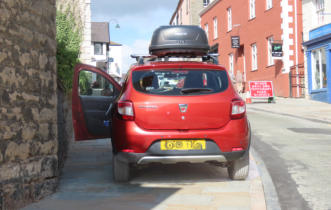
Obstructing empty
car, also with Open
door …

................................................................……………………………………….…………………….……...........
bulbs.
For the surrounding streets leading
to the Square, the Town Council
proposes reusing the existing stored
semi-circular hanging baskets as self-
watering inserts within new pots inspired
by the shape of the town’s new church
bells.
Tests of one of these proposed pots
(above) having been moved from
location to location have been
successful.
Ongoing maintenance would rely on
a mix of contractor support and
community involvement. Early and
encouraging conversations had taken
place with a local expert about
establishing a community group to help
sustain the scheme.
Ground Control
A 21st Century Phenomenon
5
St Peter’s Square
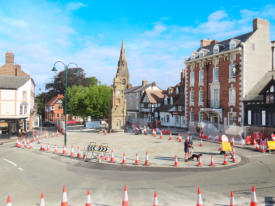
Work on the Square not due till July 2026 was
brought forward. As such, the Square is
progressing well. By the time you read this,
the work to set off The Old Courthouse will be
complete. The large reservoir space in front
does justice to the this important building.
Contractors will clear out by November
20th, 2026 for the Christmas period. It is
anticipated, at the time of writing, that they will
need at least January and some of February
to complete the entire scheme. This, then,
leaves spring and summer 2027 open to
celebrate the newness of town.
Now that the Square is already looking
better, there has been a marked upturn in
positivity. The Festival’s Top Dre reported no
problem with the new arrangement and it
even resulted in repositioning one stage to
the greater benefit of all. There is space on
the Square designated for a Christmas tree
but not a flagpole.
In August, however, attitudes to the
Square and in particular Well Street
hardened again. This was largely the result
of concerns that larger vehicles might be
unable to access the street and the turns
onto the Square. However, vehicles will be
able to do so, when finished.
There remained a majority in favour but
not necessarily on social media.
Old Gaol
Work is complete on site but neither the fit-
out nor the letting of the café is finished.
Frustratingly, there has been little progress
over the summer at 46 Clwyd Street, with a
launch now expected for the 2027 season.
Levelling Up works at Nantclwyd y Dre
are in a similar position.
Cae Ddôl
Work on the 1,600 feet of active travel route
linking the the tennis centre at Lôn Fawr to
Crispin Yard began over the summer. The
appointed contractor is also working in
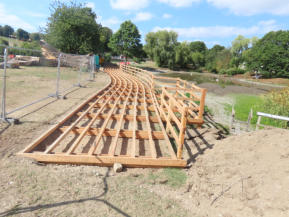
town. It includes a boardwalk at the fringes
of the Cae Ddôl lake. The County Council
in addition will replace the central bridge
over the Clwyd. Importantly, the popular
and new pump track for bicycles and skates is
currently under construction. The track will
have an uneven terrain with ramps, banked
curves, turns and mounds.
Meanwhile, the Town Council has
refurbished and returned the much-valued
rocking horse as a static item at the entrance
to Crispin Yard. Work will shortly begin to
refurbish the Crispin Yard lavatories. This is
expected to include a seasonal café with
decking, to serve parents and children
attending what will be the much-improved Cae
Ddôl park.
The Town Council is expected to take
over the running of the lavatories at least for a
fixed period (see opposite).
Work is anticipated to be completed by
next spring, with the active travel route
opening earlier.
5
It’s a struggle to get local people into
town during the public realm work on the
Square and Well Street but the hour’s
free parking initiative has nevertheless
proved successful.
It also indicates that footfall isn’t quite
as dire as it seems.
It was 12 months ago that the Town
Council introduced free parking in
partnership with car park operator
Denbighshire County Council.
An hour’s free parking is available at
Crispin Yard, Park Road and Dog Lane
car parks. Those taking advantage must
still obtain a ticket. Staying more than an
hour means you have a longer-period
ticket with the free hour automatically
added.
The most recent comparisons show
the scheme has been popular.
Taking summer figures from May to
July 2026 inclusive, during the Well
Street street works and the start of those
on the Square, overall parking was up by
about 35 per cent compared to the
previous three months of 2025.
Crispin Yard was the busiest car park
by far and grew fastest in absolute
terms. Dog Lane demand grew well
and is now often full. Park Road
declined slightly but, then again, half
of it was unavailable owing to the
public realm contractor’s compound.
People may have just avoided it.
In terms of stay duration, the one
hour ticket share jumped
considerably year on year. In fact, it
more than doubled. Understandably,
long stays fell (by a third) but the
percentage increase in one hour
parking more than compensated for a
decline in longer stays. This analysis
suggests that the huge increase in
shorter parking isn’t just the same
motorists switching to shorter stays but
also a genuine increase of additional
short term parking.
There being limited parking currently
on the Square may account for some of
this increase but, conversely, it seems
that during the May to July 2026 period
there were anecdotally many more
prepared to risk parking on Market
Street’s double yellow lines (who
presumably used to prefer the Square).
And, we do not know the potential
changes in other car parks where free
parking does not apply.
Short Stays. Big Gains
……………………………………………………………………………………………………………………….
Flush with
Ambition
In response to Denbighshire County
Council’s closure of the public
lavatory on Market Street, Ruthin
Town Council has agreed to adopt the
lavatory at Crispin Yard. This is on
condition that Levelling Up funding is
used to upgrade the block, to include
a new automated access & payment
system. The project should be
completed by next summer.
The agreement will also allow the
Town Council to provide an income-
generating community asset (a
seasonal café kiosk plus ancillary
space). This would be partly funded
by some £90,000 released from the
Sports Wales Pump Track grant. This
remains subject to planning
permission and external grants to fit
out the community space.
The original lavatory block was
completed in 1988 and rather than
the initial separate sides for women’s
and men’s lavatories has
subsequently seen the introduction of
lavatory ‘pods’.
Changes will include an additional
customer lavatory and and more
windows.
The café will be a kiosk-type
arrangement, maximising outdoor
seasonal seating.

Full up: previously a rare
site at Crispin Yard
Levelling Update
Construction of the board walk by the
summer-depleted lake at Cae Ddôl
The Square taking shape
6
6
Bryn Eryl’s Plot Twist
September 2025 and January 2026
brought improvements to the Rhyl to
Wrexham via Denbigh & Ruthin bus
service, now Traws Cymru® T51. May
2026 progressively marked the arrival of
brand new double decker buses.
The new vehicles represent a total
investment of around £2½m, underlining
a major commitment to improving
capacity and passenger comfort on the
route.
Why double deckers? It’s a fair
question, especially as buses pass
through Ruthin, where passenger
numbers are often at their lowest.
But the answer is simple: several T51
journeys regularly carry more
passengers than a single decker can
comfortably accommodate. Demand is
strongest on journeys to Denbigh, to
Wrexham and one to Ruthin, while some
peak services in and out of Rhyl also
require additional capacity.
T8 Improvements
There’s more good news on services
between Corwen and Chester via Ruthin,
Mold and Broughton Retail Park. This
became Traws Cymru® T8 in 2022.
From this September, passengers will
benefit from a new Sunday service and
larger single deck buses.
The extra capacity will help meet
growing demand, with standing
passengers currently seen on some
journeys, including, at times, those
travelling all the way from outside Mold
to Broughton.
The new buses will be no more than
three years old and will replace the
existing midi-buses, offering a noticeably
improved passenger experience.
The return of Sunday buses is
particularly welcome. The Ruthin to Mold
corridor has not seen a Sunday service
for around 50 years.
You’d be forgiven for missing the saga of
the planning application for a proposed
bungalow on a plot at Bryn Eryl, off Mold
Road.
Building a bungalow on vacant land
on a modern housing estate seemed
straightforward. The problem was that
residents had documentary evidence
that the proposal was on amenity land
designated as community space, and
have used the area to hold events over
the years.
It appears that subsequently
Denbighshire County Council sold the
plot. No one locally was aware of this.
Public opinion was very much against
the development.
The original application was pulled
before determination. A second went in
but was refused in August.
The reasons for refusal did not cite a
lack of amenity space directly. The
decision was on the basis that the
bungalow would appear cramped and
visually incongruous, failing to respect
the established character and pattern of
development in the area. Additionally, the
development would eliminate informal
open space that currently contributes
positively to the housing estate’s sense
of openness.
This is good news for those who
value community open spaces as part of
our suburban housing.
It’s round 1 to the local residents and
those who value community open
spaces. But there’s an appeal lodged.
Watch this (amenity) space, as the
(building) plot thickens…
… in one of our
shops, with
Heather
Williams
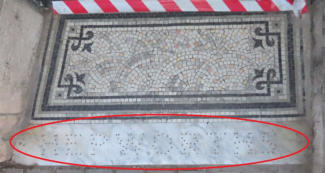
I wonder if you have ever
stepped into the Children’s
Society charity shop at the
top of Clwyd Street. If so,
have you noticed the
mosaic tiles in the recessed
entrance lobby to the shop
door? If you pause and take a closer look
you can see holes where the former
name of the shop is spelt
out—‘Hepworths’—a shop which some
readers who have lived in Ruthin for
many years may remember.
For about a century until 1985,
Hepworth’s was a thriving national chain
of men’s clothing shops, with a good
choice of ready-made and made-to-
measure suits. Hepworth’s was founded
by Joseph Hepworth (1834-1911) from
Huddersfield who followed in his father’s
footsteps and became a woollen cloth
dresser (cutting the cloth) at a local mill.
In 1864, Joseph set up a business as a
‘Juvenile Clothing Manufacturer’, with his
son Norris joining him in 1878 in the
business which was located in Leeds. It
then became known as J. Hepworth &
Son and, instead of supplying the trade,
Hepworth’s began to sell direct to
customers in Britain and abroad.
The decision was taken to open shops
in all important towns as rapidly as
possible. Among the first shops which
opened in 1884 were those in
Birmingham and Derby. In 1891, they had
81 shops and by 1914 Joseph Hepworth
& Son was probably the largest clothing
manufacturer in the country. Hepworth’s
changed its image in 1961 when it began
opening shops named ‘The Hardy Amies
Tailoring Shop’ within several
Debenham’s department stores.
Hepworth’s changed its direction
again in the 1980s, when the company
bought the women’s wear chain Kendall &
Sons, which was then used to launch a
new chain of shops called Next. It proved
so successful that Hepworth’s name
disappeared from the high street by the
end of 1985, absorbed by the new brand.
However, some fragments of
Hepworth’s have survived, such as
Hepworth’s Arcade in Hull and entrance
lobbies which remain a feature of
traditional historic shop fronts in Penrith
and Blandford Forum.
In the mid-20th century, Hepworth’s
shops were characterised by deep
entrance lobbies which maximised the
window display area, just as we have
here in Ruthin. The beautiful hard-
wearing tiles are typical of the intricate
black and white checker-board or mosaic
patterns which were popular in the late
19th and early/mid part of the 20th
century.
While not perfect, they are still in
pretty good condition and have survived
countless people stepping on them. Low
stall risers were installed, which means
the clothing was brought to the same
level as ‘window shoppers’ and deep
fascia boards for the signboards with
large lettering advertising the name of the
shop were simplified to read ‘Hepworths’.
The tiled entrance lobby survived the
significant renovation of the shop in 2009
and previous renovations.
This is one of the small local
architectural shop front features which
need to be retained to help the town
retain its character.
■ These days, it is almost inconceivable
that a town centre the size of Ruthin
should feature a nationally known retailer.
Hepworth’s was not the only national
chain or brand. The fact that they have all
but disappeared from town centres of our
size indicates the monumental change we
have seen in retail, travel, home
deliveries and towns.
■ There is a picture of Ruthin’s
Hepworth’s at francisfrith.com. Search
within for ‘Clwyd Street 1939’.
Stepping into History…
................................................................……………………………………….……………………..............

Double
Delight

7
by Heather Williams
As many readers will know, in the small
hamlet of Llanrhydd about a mile from
the town centre of St Peter’s church is
St Meugan’s. This was the original
mother-church of the Welsh settlement
which subsequently became Ruthin.
The church is dedicated to St Meugan,
a monk in the golden age of Welsh
Saints in the 6th and 7th century.
The present limestone and
sandstone building with a Welsh slate
roof dates from the 15th century. Inside,
one of the key features is the beautifully
carved wooden oak rood screen
(between the nave and the chancel),
which dates back to the late 15th
century and is one of the best in the
Vale of Clwyd. Other notable features
are the stone memorials of the Thelwall
family, dating back to the 16th and 17th
century, who lived at nearby Bathafarn.
Outside is the shaft of a stone
preaching cross which dates back to
the 1670s. There are also many
interesting grave stones. One is at the
east end of the church and marks the
death of John Jones who was a Ruthin
draper who was killed by a fall from a
gig in 1835.
Another interesting gravestone in
the north east corner of the churchyard
is one recording the death of Alfred
Corbett, a tramp, who came to the end
of his road in 1947. Finally, Stanley
Weyman, a popular author in the late
19th/early 20th who lived at Plas
Llanrhydd was buried here in 1928.
Like many rural churches, the
worshippers have declined over recent
years. Before the pandemic only
occasional services were held. Now, the
services held are pre-planned ones,
such as christenings, weddings and
funerals.
A couple of meetings were recently
organised to discuss the future of the
church. It is clear that it requires some
practical help to care for the church to
keep the church open for future
generations. It was decided to
encourage volunteers to come along on
a Saturday morning once a month from
10a.m. to 12.00 noon. The first session
was held on July 25th, with the following
sessions on August 29th and
September 26th.
I attended the first session, when
the local mission area lead Revd Diana
Greenfield explained the situation to at
least a dozen or so volunteers, whose
age ranged from young to old. People
introduced themselves and had different
reasons for coming along: quite a few
had family connections, but others were
interested in caring for the heritage.
Some helped to clean the inside of the
church, much needed with spiders and
other insects having decided to take up
residence. There are also bats there,
but none were seen in the daylight.
Others set to work outside with
secateurs trying to tame some of the
vegetation, such as the ivy and various
bushes. At the end of the session you
could see that even an hour or two of
volunteer time did make a difference so
let’s hope the enthusiasm continues.
■ For more information on the three
graves mentioned here, search
findagrave.com by using the deceased
person’s name.
A brand new licensed restaurant has
just opened near The Square, writes Liz
Williams. All fresh, locally-sourced food
will be simply cooked and presented at
The Hide.
The Hide, at No. 1 Prior Street,
which is literally hidden away from view
on Prior Street, was previously The
Smithy, where horses were shod and all
kinds of foundry work was undertaken.
A huge cast iron round-barrel boiler was
found on site when clearing it. It is
possible that hops and barley for beer
making from local pubs would have
been prepared here. Together with the
intriguing three-storey 1A immediately
above it, the building is grade II listed.
Cadw states this is because of the tall
and narrow no. 1A and the retained
form of no. 1, The Smithy.
Two brothers of the Williams family
lived here for many years and ran the
Smithy and there’s evidence of a busy
foundry there, until the 1960s.
In 1984, local businessman Peter
Jones took over the property and had a
workshop there as a base for his
successful building and repair business.
Jones, now semi-retired, has long had
an interest in the food trade and now
looks forward to a new challenge of
running The Hide with Head Chef Matt,
who used to chef at the Rug Estate,
barman Stewart, and four extra staff to
look after you.
All patisserie and ice cream will be
made on site and a huge range of
Welsh speciality beers and Wrexham
lager are offered. With growing facilities
on site, most vegetables will be truly
local.
There will be specials on the menu
and two and three course meal offers.
Birthday, anniversary and wedding
celebrations will be catered for and The
Hide will be open Friday and Saturday
12 noon to 4 pm then 5 pm to last
orders at 9 pm. Sundays will see mainly
traditional roasts (12 noon till last orders
at 7 pm).
The restaurant seats 34 and in
addition there are outdoor tables with
stunning views across the Vale.
Planning permission for the change of
use to a restaurant covered the building
itself and it’s likely that permissions for
the use of the outdoor space will need
catch up.
This nevertheless is precisely what
Ruthin needs: a good quality offer to
diversify its hospitality base.
7
Caring for St Meugan’s Church
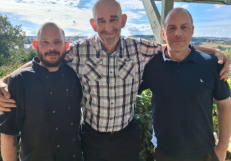
As a long-standing member of the Civic
Association, the late David Castledine
is remembered for both his knowledge
of Ruthin and the surrounding area,
and for his quiet, steady contributions
to local life. He died peacefully in
Ashbourne, aged 76.
Those who knew him spoke of his
amazing knowledge and memory of the
local area. He had worked in the Clwyd
Record Office and then on the same
site in Ruthin at the Denbighshire
Record Office, staying there from the
1970s until his retirement.
David was also described as an
author with a deep connection with
local history. He compiled ‘Historic
Ruthin’ while assistant archivist,
published by the Clwyd Record Office
in 1979. It still remains a go-to source
of information. He went on to produce
numerous articles, often for the
Denbighshire Historical Society,
including one on the origins of that
society itself.
In addition to his writing, he
contributed to research for articles
covering a significant number of
subjects. He also helped others learn
by teaching at evening classes, and he
served as a town guide, bringing local
stories to life for visitors and residents
alike.
David Castledine was a member of
Ruthin’s English Presbyterian Church,
and he remained active while in Ruthin
in a range of interests beyond history
and research, including Scottish
dancing and chess. He had learnt
Welsh to a good standard.
Latterly while in Ruthin, he had
been a resident of Abbeyfield.
Remembering David Castledine
Hidden History
at The Hide


8
The Civic Association year 2025/26 has
proven to be less active than in previous
years. There has also been some
considerable introspection as to the
future of the organisation.
Nevertheless, membership of the
Civic Association remains stable and,
again, we have maintained a healthy
financial position, with balances of about
£7,000, similar to 2024/25.
During the year, the Committee has
given much thought to the Civic
Association’s future. We feel that much
now depends on new ideas and ‘new
blood’. The current Committee has been
in post in some cases for almost as long
as the Civic Association itself. Not only is
this unhealthy, in time it can stifle
creativity. A number are looking to step
down but, understandably and gratefully,
are loathe to do so without
replacements.
These days, volunteers are certainly
difficult to come by, no matter the
organisation. Our appeal in June’s Town
& Around brought forward a couple of
people who may be interested and who
may be able to help. A subsequent
summer drive using wider means (social
media) has to date garnered no realistic
responses.
This is a topic we shall need to
address fully at the October AGM
following the September close of the
Civic Association’s year. There are no
immediate plans to do something
precipitate.
On more routine matters, the Civic
Association considered a number of
planning applications, including at Pool
Park, Rhos Street School, Myddelton
Arms and Llys Famau. During a well
attended evening in December, those
behind the Peers Memorial received the
annual Quayle Award. There followed a
quiz by Ian Lewney. Two months before,
Fiona Gale had addressed the Civic
Association AGM. 20 people attended a
thoroughly interesting talk by Brian
Hubble on the geology of Ruthin’s
buildings and the links between our
streetscape and local stone. This was
highly relevant, given that link was now
well and truly broken in Ruthin, with the
use of granite kerbs for Levelling Up
works from India and York stone from
China.
With the help of Friends of the Earth,
the Civic Association organised a
hustings ahead of the May 2026 Senedd
elections.
Uncertainties surrounding the
Square Levelling Up project at the time
of planning Open Doors resulted in
uncertainty for the 2025 event. This was
a particular shame because, as we
approached the autumn, it was clear that
there were significant delays in the start
of the levelling up works.
I should therefore like to thank
Heather Williams for her hastily-
arranged ‘Mini Open Doors’ in
September, and the volunteers who
helped staff The Old Courthouse. The
Old Courthouse was available for a
weekend, with an exhibition of some of
the Town Council artefacts (paintings,
silverware, mace, robe, etc., with
suitable information) and also
information about the Peers Memorial
clock tower (with guided tours).
Refurbished Plas Coch and some other
properties were open. Given the notice,
numbers were encouraging.
These Public realm works continue
and regrettably have blighted Open
Doors 2026, too.
The Town and Around journal
continued to be the most tangible part of
the Civic Association’s work, with its
usual diverse mix of interesting &
relevant articles and news items. This is
now generally accepted by those who
read it as an important part of the local
community, with much praise from
members and non-members alike. Yet,
the editor can only produce what he has
to hand. It is a great credit to him that
the four editions were so full. Even so,
that for March 2026 was eight rather
than the usual 12 pages. We cannot
print what we do not have: again, I urge
members and readers to consider how
they might contribute in the future. They
can offer the occasional full article,
suggestions, or a list of bullet points that
the editor can use to craft a piece.
Without these, Town and Around cannot
fulfil its expectations. May I warmly
thank the contributors and in particular
editor Peter Daniels who has the task of
stitching together the articles and
photos. In 2025/26, we published 30,226
words. Although this is down when
compared to 2025/26, Town and Around
remains a credible source of news.
Overall, this year saw the Civic
Association consolidate its finances and
membership while remaining active in
safeguarding as best it can Ruthin’s built
heritage, contributing to major
development discussions, and providing
cultural and historical resources for the
community.
I thank the 2024/25 Committee for
their help, support and contributions
during the year. At the close of the Civic
Association year, they were Anne
Roberts (Chair), Heather Williams (Vice-
chair), Robert Williams (Hon. Treasurer),
Peter Daniels (Secretary), Steve Beach,
Kay Culhane, Kathy Daniels, Menna
Jones and Liz Williams. I should also
like to mention with thanks that during
the year the office holders of the Vice-
chair and Secretary switched, to allow
Peter to undertake his 2025/26 mayoral
role.
Last but certainly not least, may I
thank our membership for their
continued and valued support.
Anne Roberts MBE
Chair of the Civic Association 2025/26
8
Civic Association Annual Report 2025/26
……………………………………………………………………………………………………………………….
Notice of AGM 2026
The Civic Association 2026
Annual General Meeting will be
held on October 15th at 7.00 p.m.
at The Old Courthouse, Ruthin.
We shall send the minutes of the
2025 AGM as usual by email.
1.
Apologies for Absence
2.
Minutes of the Annual
General Meeting held October
15th, 2025
3.
Matters Arising
4.
Chair’s Annual Report (above)
5.
Treasurer’s Report &
Accounts
6.
Future of the Civic
Association
7.
Election of Officers &
Committee 2026/27
8.
Any Other Business
9.
Guest Speaker on the
regeneration project at 46
Clwyd Street (Old Gaol)
Annual subscriptions for the year
September 2026 to August 2027 fall due on
September 1st, and remain the same for
the thirteenth year, namely £10 for
individuals and £15 for joint/family
membership.
We know from feedback that over the
years the work and activities of the Civic
Association have been greatly appreciated
including the annual Open Doors events
and our quarterly newsletter, Town &
Around. However, as stated in our previous
edition, our existing committee members
have all been in post for a considerable
time and there is a need for new people to
fill posts on the committee to enable the
Civic Association to continue its primary
role in securing the preservation,
protection, development and improvement
of features of historic or public interest in
Ruthin and the surrounding area. Unless
we are able to do this there is a real danger
that the Civic Association will be wound up.
If therefore you are reading Town &
Around and are not yet a member please
consider joining the Civic Association to
support its activities.
The membership form for both
prospective new members and also existing
members who do not yet pay by standing
order is opposite. When completed, this
should be returned to the Honorary
Treasurer, RADCA, Lenton House, Mold
Road, Ruthin LL15 1SL. (Scanned copies
can be sent via email to
ruthincivic@btinternet.com and
subscriptions paid by bank transfer to the
account shown).
Please note that no action is required
for members already paying by standing
order.
For any queries please email the
Treasurer at: ruthincivic@btinternet or
telephone 704998.
RADCA Subscription Unchanged for
13th Consecutive Year


Cymdeithas
Ddinesig Rh
ut
hun
a’r Cylch (CDdRhAC)
T
anysgrifiad Aelodaeth Blynyddol (1af Medi I 31a
in Aws
t) - Unigolyn: £10 Dau/Teulu: £15
(1)
Teit
l:…………… En
w…
………….
:………
………………
………………
………Cyf
en
w:…
………………
………………
………………
………………
………………
.
(2)
Tieitl:………
……E
nw ………
…..:…
………………
………………
…………..,,Cy
fe
nw
:……
……
…
…
………
……
……
……
……
…
……
……
…
…
………
……
……
.
Cyfeiriad:………
…………
……
…
……
……
…
…
………
……
……
……
……
…
……
……
…
…
………
……
……
……
……
…
……
……
…
…
.
Cô
d
Post:
…
……
……
…
…
……
Ffôn
:
…
………
……
……
……
……
…
……
……
…
…
Ebos
t:……
………
……
……
……
………
……
…
…
……
………
……
……
……
………
……
…
…
……
………
……
……
……
….
Rwyf/Rydym yn dymuno ymuno â
CDRAC – Ticiw
ch/dileu’r c
anlynol yn ôl yr
angen
:
Rwyf/Rydym wedi gwneud
trosglwydd
iad
ban
c o
£1
0/£15 ar
gyfer y flwyddyn
bresennol……
………………
………...
Rwyf/Rydym wedi sefydlu arche
b sefydlog flynyddol o £10/£15 ar
gyfer y blyn
yd
doedd
i dd
od
yn
dda
ladwy
ar Medi 1af
bob blwyd
dyn.
………………
………………
………………
………………
………………
………………
………………
………………
..
I: Ruthin & Dis
trict Civic Association – A/c HSBC, Rh
uthun
Côd
Didoli: 40-39-16 A/c: 8
1137514 –
Defn
yddiwch
eich
cô
d p
ost fel cyfeirno
d.
NEU: R
wy
f/Rydym yn amgau siec (neu arian parod) am £1
0/£15 yn d
aladwy
I
Cymd
eithas
Dd
inesig
Rhuthu
n
A’r
Cylch – anfo
n
er
i:
R H Williams, Tryso
rydd, CDRAC, Lent
on Hou
se, Mold
Road
, Rh
uthun
LL15 1SL
Cymorth Rhodd/Giftaid eich taliad
(dewi
sol)
Rwyf/Rydym yn talu
treth
y DU ac yn d
ymun
o
i’r ta
liad
ac un
rhyw d
aliad
a wn
eir
yn y blyn ddoedd
I dd
od neu
a wnaed yn y 4 blynedd
diw
ethaf fo
d yn
Gy
morth Rh
odd. R
wy
f/Rydym yn d
ea
ll os byddaf/byddwn
yn tal
u
ll
ai
o Dreth Incw
m
a/
neu D
reth E
nill
ion
Cyfalaf na swm
y
Cymorth Rhodd
a
hawliwyd
yn y flwyddyn h
onno, mai fy
nghyfrifold
eb I
/ni yw t
alu unr
hyw wahaniaeth.
Elu
sen Gofrestredig 702203
Ru
thin & District Civic Association (RADCA)
Annual Membership Subscr
iption
(1
st
September
to
31
st
August)
– Ind
ividual: £10 Join
t/Fa
mily: £15
(1)
Title:…
…………...
Name:……………
………………
………………
……Surname:…………
……………
…
…
……
……
…
……
……
……
……
………
…
…
……
……
…
…..
(2)
Title:…
……………
Name:………………
………………
…………………Surname:……………
………………
………………
………………
………………
………………
..
Addr
ess:……………
………………
………………
………………
………………
………………
………………
………………
………………
…..Pos
t Co
de:………………
………..
Telepho
ne:…………
………………
………………
………..Email:…………
…
……
………
……
……
……
………
……
…
…
……
………
……
……
……
………
……
…
…
……
……
…
I/We wi
sh to
join RADCA
-
Please tick/delete the
follow
ing
as
appropriate:
I/We have made a b
ank transfer of £10/£15 f
or
the present
year
………………
………………
………………
………………
.……
..
I/We have set up an annual stan
ding
order
of
£10/
£1
5 fo
r
fut
ure y
ears payable on 1
st
September
each y
ear…….
To: Ruthin & Distr
ict Civic Association – A/c HSBC, Ruthin
So
rt
Code: 40-39-16 A/c:
81137514 – Please use yo
ur pos
tcod
e
as r
eferen
ce.
OR: I
/We enclose cheque (or cash) f
or
£10/£15 pay
able to Ruthin & D
is
trict Civic Association
- send
to:
R H Williams, Treasu
rer RAD
CA, Lento
n H
ouse
, Mol
d
Road, Ruth
in
LL15 1SL
Gift
aid your payment (optional)
I/We pay
UK tax an
d wish payment and
any payment made in futur
e years or which have b
een made in the past
4
years
to be Giftaided
.
I
/we understand that if I
/we pay less Inc
ome and/or
Capital Gains
Ta
x tha
n the
amoun
t of
Giftaid claimed in that y
ear it is my/our responsibil
ity to pay an
y
differen
ce.
Regi
stere
d Ch
arit
y No. 702203
9
................................................................……………………………………….………………
10
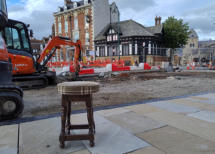
Those working in the public space on
Well Street and on the Square during
the summer have had to ensure searing
temperatures while clad in the plastic of
the obligatory high-visibility jackets and
hard hats. They worked especially hard
to ensure the Square could be handed
over to for the Festival’s Top Dre in
early July. Little wonder, then, that we
found a nicely upholstered stool and a
fold-away camping chair to offer
workers some comfort, even though
both were unlikely to meet modern
health & safety regulations.
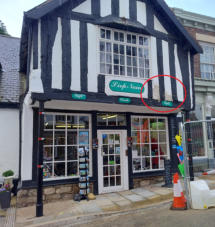
There were some hairy moments when
the contractors were working on the
footway beneath one of our most
important heritage buildings, Siop Nain,
Well Street. A chunk of plaster fell off
and there was concern that the
vibrations associated with drilling might
cause further problems. In the event,
the contractors left part of the concrete
footway around the support in place.
Siop Nain, meanwhile, took advantage
of the road closure to install scaffolding
to give the building a paint-up.
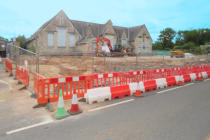
It is unusual indeed to see drainage
work on a housing development site
before the demolition of buildings
thereon. But this was exactly what
happened over the summer, as work
started on the former Rhos Street
School site. The imperative was to
complete works fronting Rhos Street by
the end of August, before the start of
the new academic term, to ensure that
the otherwise ensuing traffic chaos
would be kept to a minimum. It
necessitated the demolition of the
boundary wall and its reconstruction(but
not to its original height). In addition
were kerb lines and footway works,
including the introduction of a dropped
10
kerb. Now complete, we can anticipate
a full demolition of the buildings that sit
so comfortably within their immediate
area.
Has the summer exhibition at the Craft
Centre reached new heights in terms of
the asking price for the art on sale?
Some of the Halima Cassell gallery 1
items were selling at £30,000 and more.
Another summer and another patch of
unproductive, weed-strewn ground as
you approach the Co-op car park.
Similarly, in the Craft Centre car park.
They do not offer a particularly good
welcome to locals or visitors. Once,
those in the Craft Centre were bursting
with wild flower colour. Could these
barren patches of land be put to better
use? Could they help contribute to
biodiversity and support pollinators?
And talking of pollinators, this summer’s
buddleia to the rear of the former Rhos
Street School has proven to be an
exceptional. The fauna this year were
outstanding and not a wildflower
meadow too nearby. Pity that these will
go with the buildings.
2026 has been a ‘good’ year for our
gulls. Unlike last year, gulls have
multiplied. The August 12th eclipse was
disappointingly partly obscured in
Ruthin by cloud. But it did give us some
respite from the continual squawking,
as even the gulls packed up for 10
minutes at the eclipse’s height. Never
fear, they were back out again soon
afterwards…
20 Years Ago
Our Tesco store opened 20 years
ago… just at the conclusion of
Tesco’s pile ’em high sell ’em cheap
era.
Comparing Tesco when it
opened on the last day of July 2006
to today and there are some
interesting changes.
By way of a birthday treat, in July
Tesco installed yet further CCTV,
this time at a number of self service
checkouts. They join the 37 already
in store (and eight outside). Bro
Rhuthun, the Rhuthun/Ruthin Blog
called this the most spied-upon
space in town. Needless to say,
there were none 20 years ago.
In 2006, Tesco sold some
domestic appliances. These
includes toasters, hair driers,
microwaves, kettles and vacuum
cleaners. Most of these remain,
though the range has shrunken, and
there are no kettles at £5 as before.
Hoovers and microwaves have
gone.
Also in 2006, Tesco sold laptops,
but no more. There is nevertheless
now a range of (fairly basic)
smartphones on offer. Smartphones
were almost unheard of in 2006.
Tesco now has a large number of
leads, phone covers and similar.
The Tesco of 2006 sold a small
range of clothing: underwear, socks,
tights, t-shirts, etc. That’s also gone
by the wayside, though over the
summer there appeared a single rail
of eclectic clearance clothes
immediately to the left of the
entrance.
Space devoted to wines and
beers has increased. Food fashions
have changed but the food offer is
broadly the same as it was at the
start. There’s now a section for
those with certain intolerances.
There’s noticeably fewer organic
food products, though. Tesco refers
less to local produce (‘local’ in 2006
meant Wales, rather than
Denbighshire).
Perhaps the biggest change is
this: Tesco in 2006 seemed more
distinctive and ambitious in some
ways, even significant, whereas
today it feels more like just a part of
the mainstream retail mix—still an
important presence in Ruthin, and
still among the town’s largest
employers, with around 150 staff.





Seen in Passing…

Last November, a National Emergency
Briefing was held which brought
together leading UK experts in climate
science, food security, health,
economics, national security and nature.
It presents a clear, measured
overview of how the climate and nature
crisis is affecting everyday life in
Britain… and what the evidence says
about risks and responses.
The initiative is explicitly non-
partisan and has support from a wide
range of organisations including
National Trust, Church of England,
Exeter University, the Royal
Meteorological Society, WWF, National
Education Union, and many more. Its
purpose is to support informed
democratic discussion and ensure that
the UK parliament (and potentially the
Senedd) and the public share a common
understanding of the scale and urgency
of the challenge.
The issues and various solutions
were suggested by speakers who gave
presentations on the topics below:
● Weather Extremes: Professor Hayley
Fowler
● Climate: Professor Kevin Anderson
● Tipping Points: Professor Tim Lenton
OBE
● Nature: Professor Nathalie Seddon
● Food Security: Professor Paul
Behrens
● Health: Professor Hugh Montgomery
OBE
● National Security: Lt General Richard
Nugee, CBE
● Economics: Angela Francis
● Energy Transition: Tessa Khan
A summary of these were edited into
a 50-minute film which is being
screened as the People’s Emergency
Briefing across the UK. This has been
shown at two venues in Ruthin, at the
Naylor Leyland Centre in June and the
Assembly Rooms in July. A further
showing could be at the Old Courthouse
in the autumn.
So that the public is informed,
prepared and projected, the National
Emergency Briefing now wants the
following actions to be taken:
● More people to watch the film by
attending one of the community
screenings of the film and also having a
prime-time, multi-channel televised
national emergency briefing to the
nation.
● The UK Government to launch a
science-led national response to climate
and nature breakdown, to include
emergency legislation to drive down
reduction in emissions and to also invest
to adapt to a more dangerous climate.
● Help lead a stronger global action by
taking the above steps.
You can see a trailer of the PEB film
at nebriefing.org/the-film
For more information about the
National Emergency Briefing (and the
film, referred to as ‘People’s Emergency
Briefing’) see www.nebriefing.org.
■ If you are interested in the original
talks, delivered in London last
November, you can watch them at
nebriefing.org/expert-briefings or read
the one-page summaries of each talk at:
drive.google.com/file/d/1P9uT3P_EPZ5J
P3xk5YuK_OYjGOGGTOES/view
National Emergency Briefing
11
by Peter Daniels
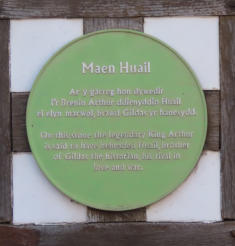
Maen Huail in St Peter’s Square, Ruthin,
sits in full view of passers-by and, for
some, comes with a clear Arthurian
story: a tradition that King Arthur
beheaded Huail, said to have been
Gildas’s brother. A nearby plaque
repeats that tradition, and it’s easy to
see how such a tale gains traction in an
area some argue is known for its
Arthurian legends.
But not everyone is convinced. Some
people would rather the plaques linked
to the story were removed, arguing that
Maen Huail is nothing more than a
geological ‘erratic’, a wayward stone
deposited by natural forces. Others,
however, have a different instinct: they
would keep it where it is, because the
legend adds local colour, and myths like
these help give places their character.
Who actually knows whether the
plaque’s claim is ‘right’? The truth is that
even the origin of the tradition is
uncertain, and the story may owe more
to oral telling than to any firm record.
What can be said with more
confidence is that the stone itself has
often been treated as a public feature. It
has been described as a craggy, heavily
weathered limestone boulder, and it has
been suggested that it may have served
practical civic purposes, such as a
market or meeting stone, or even as a
preaching stone, rather than a stage for
King Arthur’s dramatic moment.
The point is, where would Beddgelert
be without its famous myth? Should
Ruthin have its own, too? And we need
all the visitors we can get.
Passers by who visit often stop and
ponder the plaques and the boulder. We
don’t suppose that there are many
visitors who come purely for Arthurian
links, yet those who do clearly want the
story as much as the stone. This
summer, a group of 10 Norwegians,
informed sources report, each
lined up to kiss it, an
affectionate reminder that
legends, however contested,
still draw people in.
If nothing else, Maen Huail
shows how Wales can be:
infused with historic echoes,
comfortable with uncertainty,
and unashamed to let a little
story live alongside the rock.
■ Should the myth go with
the removal of the plaques?
What do readers think?
Please write to us (p12)
Ruthin Lending Library isn’t just a library,
it’s a vibrant community hub, writes
Bobby Feeley. I recently discovered why
during a visit alongside Denbighshire
Chief Executive Helen White, Head of
Service Heidi McDougal, and Library
Manager Vanessa Hill (pictured).
Walking through the doors, the
energy is unmistakable. Yes, there are
books, shelves of them, but that’s only
the beginning. Free technology support,
job clubs, storytelling sessions for
toddlers (Book Start and Rhyme Time),
craft circles, reading groups, and face-to-
face advice for social care needs all
thrive under one roof. It’s a masterclass
in what a modern library should be.
The gem I didn’t expect? Tucked
upstairs is a Citizens’ Advice
Denbighshire office, a quiet corner staffed
by knowledgeable advisors ready to
tackle everything from minor queries to
major life problems. And then there’s the
basement: a hidden archive of Ruthin’s
history, waiting to tell its stories to anyone
curious enough to venture down.
The full circle
moment came
when I realized I’d
stood in this very
building decades
earlier, back in
1986, when it
served as the
Council Chamber.
Watching it
transformed into
the thriving library
feels like witnessing
a community
investment that’s
truly paid off.
……………………………………………………………………………………………………………………….
A Boulder with a Backstory: local colour
or misplaced history?
Where Books Are the
Opening Chapter


12
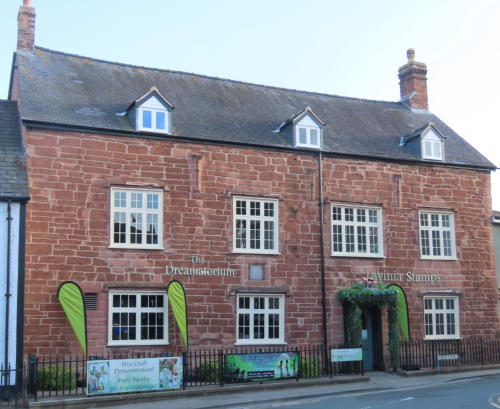
The 2025 Quayle Award
winner is Lavina
Stamps’ conversion of
Plas Coch, Well Street.
This is what they’ve
achieved, explains
Kath Daniels
Plas Coch has undergone a
transformation that, at first, many people
thought would never happen. After it had
previously operated as a social club and
then closed, the predictions had been
grim: the place would simply rot.
Instead, Lavinia Stamps set out to
strip everything back and rebuild it
properly. The brief was to ensure the
building’s character survived but with the
structure and layout reworked for its
next purpose. Paint was removed from
the wooden fabric of the property using
water pressure rather than sandblasting,
a choice that was said to help protect
what was worth keeping.
The ground floor was remodelled in
a way that included moving the
lavatories. In one place, a small section
of wattle and daub is now visible, and
even that is presented behind a special
covering, keeping it protected while still
allowing visitors to see a trace of what
the building once was.
Those close to the work had
described the builders as remarkably
sympathetic. They worked alongside the
County Council’s Chris Evans and the
project also incorporated part of the
exterior into the interior, creating a
sense that the building’s past had not
been erased, but rather re-framed.
A new ground floor kitchen has been
created to support workshops and the
growing number of attendees. It was
reported that the expectation is no
longer ‘just coffee and cake’. There is a
hope, in time, to expand the food offer
further. From the first floor kitchen,
access leads out to a balcony where the
team intends to grow vegetables, linking
refreshments directly to the life of the
site.
The first floor has been set aside as
office space. The former boardroom has
been by two offices and a corridor
leading to lavatories. One room has
been dedicated to video filming,
reflecting the way the workshops are
developing beyond purely in-person
activity. Meanwhile, the fully equipped
flat in the attic can be used by those
attending workshops, with the income
from that facility said to help defray the
obvious running costs of the building.
Alongside the sleeping area are two
sofa-beds.
The attic work also required the
removal of older stub partitions. During
that process, there had been concerns
about the potential presence of
asbestos. The contractor made a hole in
the ceiling, stuck his head through, and
exclaimed, ‘Wow!’ Throughout, the
builders carried out the changes
carefully
Elsewhere, the flat was reportedly
stripped back to the beams, letting the
structure define the space. The outer
staircase, meanwhile, was designed by
Lavina Stamps themselves.
Many locals may remember the area
where you could once play pool. That
space has now been repurposed as the
main workshop area. There is also a
large storage area on the ground floor,
giving the operation the room it needs to
run smoothly.
Looking ahead, the plan over the
next twelve months is to expand food
production on site. People involved in
the project believe it could eventually
become another café in town, though
the emphasis, for now, remains on
building gradually and making the
business work as a workshop venue
first.
Overall, it has been described as a
remarkable business transformation:
from Lavinia’s own garage into the
thriving new life of Plas Coch.
Meanwhile the workshops are said
to be going well. Visitors, are coming
from all over the world. The company
tries to keep as much rooted in Ruthin
as possible, providing customers with
details of local facilities, hospitality, and
accommodation.
At Plas Coch, the result has not
been a quiet decline after closure, but a
deliberate reinvention, one that,
according to those involved, lets the
building’s story carry on, even as its
future takes shape.
12
Town & Around is published
quarterly by the Ruthin & District
Civic Association. It is available from
Ruthin Library and on
townandaround.org.uk. It is delivered
free to Civic Association members
Editor, Layout & Design: Peter
Daniels
Secretary: Peter Daniels
cymru@clwyd.org
We welcome articles,
contributions, suggestions and
letters in Welsh or English
Please send them to the Editor at
cymru@clwyd.org or
Coedlan, 25 Stryd y Brython,
Ruthin, LL15 1JA
The deadline for the next edition is
November 15th, 2025
Thanks are due to this quarter’s
contributors: Kath Daniels,
Peter Daniels, Bobby Feeley,
Anne Roberts, Heather Williams and
Liz Williams
Views expressed by contributors
are their own and neither
necessarily reflect those of the
Civic Association nor those of
their employers
© September 2026
Ruthin &
District Civic Association
Fran Smyth
Lavinia Stamps
her Mark
