The 1988 Town Centre Study
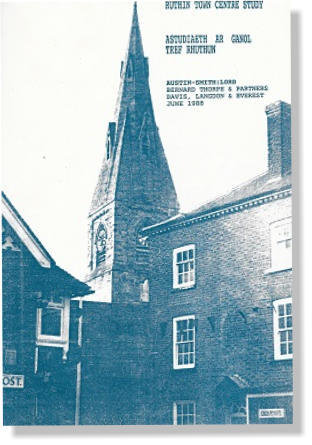
The 1988 Austin Smith Lord Town Centre Study was the focus of the first proper
meeting of the Civic Association. PETER DANIELS considered the plan and its
impact
Till the 1988 Austin Smith Lord development
plan, no one had been thinking strategically
about Ruthin and its direction & needs. Jointly
sponsored by three stakeholders, the plan was
designed to cement a new consensus regarding
the town’s future. The partners were Clwyd
County & Glyndŵr District Councils and the
Welsh Development Agency (all of which, of
course, are no longer with us).
The main objectives of the study were to
provide new facilities for commercial & social
benefit; generate income; resolve traffic and
parking issues; and to enhance the environment
of the town.
Plans such as these never totally come to
complete fruition, not as originally intended. In
a sense, they are a focus for discussion, a
foundation or a set of principles. Some
elements of the study were dropped, while
others were modified. The 1988 plan did,
however, set the seeds of change for the 1990s
and even into the early 2000s.
The report looked at seven principal sites within
the town centre: the town hall &
slaughterhouse; the county offices at that point
occupied by Glyndŵr Council; the gasworks; the
car park on the opposite side of the road to the
Craft Centre; land at the junction of Park Road &
Canol y Dre; and both the upper and lower
agricultural markets.
The main impetus was to move the agricultural
markets from the town centre although, at the
time, the site owners had not expressed a wish
to go. This would nevertheless unlock
development potential. The markets brought
with them significant local traffic problems,
including ever-longer stock wagons. Between
1983 and 1988, throughput at the market had
increased by 60 per cent and it was anticipated
to grow at a further five per cent per annum for
the foreseeable future. Planners felt that the
markets needed room to expand and the report
favoured three potential sites, at Lôn Cae Bricks;
the junction of Park Road/Canol y Dre; or the
junction of Lôn Fawr & Mwrog St.
Any such move released land at the lower
market for redevelopment. In fact, it was
envisaged that this retail development would
not only fund the market’s move but it would
result in ensuring the “long-term viability of the
mart and of the town centre”.
That redevelopment would retain two
faces of the county offices (today’s County Hall
frontage on Market Street & Wynnstay Road);
demolish the rear buildings, outliers and
“temporary” (actually by then semi-permanent)
accommodation; and see new Glyndŵr offices
at the Old Station Yard roundabout (now named
the Briec roundabout), occupying the old
gasworks site.
Recognising that the town had no significant
supermarket, the redeveloped lower mart site
would have an anchor grocer and, interestingly,
an arcade of additional shops with it. The report
conceded that Ruthin’s catchment was
insufficient to attract a “main retailer”, although
in 2006 this was turned on its head when Tesco
developed land off Lôn Parcŵr which in 1988
was earmarked for housing.
The market did
move in 1992 (to
Glasdir), when
Argyll Stores
(Properties) Ltd
purchased the
lower market for
the construction
of a Lo-Cost
supermarket (the
current Co-op).
There were no
associated smaller
shop units built.
Smith Austin Lord
called for the
development to
have a “strong
architectural
identity”. Readers will have their own views as to
whether the design with its unscreened delivery
bay achieved this. The Association called it an
“architectural and planning mess”.
The 1988 study suggested that the old Market
Hall, Town Hall & slaughterhouse site should be
converted into craft workshops, thus re-
enforcing the principle of Ruthin being a hub for
crafts allied to the Craft Centre. This never came
to pass.
It was suggested that the upper agricultural
market adjacent to Market Street car park
should become a new health centre. This would
replace outdated facilities. In reality, the Market
Street/Mount Street general practice alone
relocated to the gasworks site as Plas Meddyg.
This location was initially designed for Glyndŵr’s
offices and was never developed as intended. It
was only from 2003 when the new Denbighshire
rebuilt and remodelled its council offices.
What impact did the eventual part-development
have on Ruthin? From 1992, post-Lo-Cost, the
town at last had a larger supermarket, even
though it was not one in the premier league.
Some town centre grocers and other
convenience retailers closed but there is no
doubt that the mart area was improved
environmentally.
The agricultural mart’s move from the town
centre in 1992 allowed it to modernise and, in
particular, expand into one of Wales’ major
markets, something that was impossible in its
previous substandard and split locations.
One unintended consequence was a drop in
town footfall, as farmers or their accompanying
wives no longer took to town on Thursdays &
Fridays. No longer was it so easy for visitors to
watch the auctions.
Ruthin gained a modern medical facility
(subsequently extended), even though the
Austin Smith Lord study envisaged this on
Market Street. Instead, Glyndŵr extended
Market Street car park in 1993.
The remaining changes occurred after new
Denbighshire considered its own development
proposals for Ruthin, in the early 21st century.
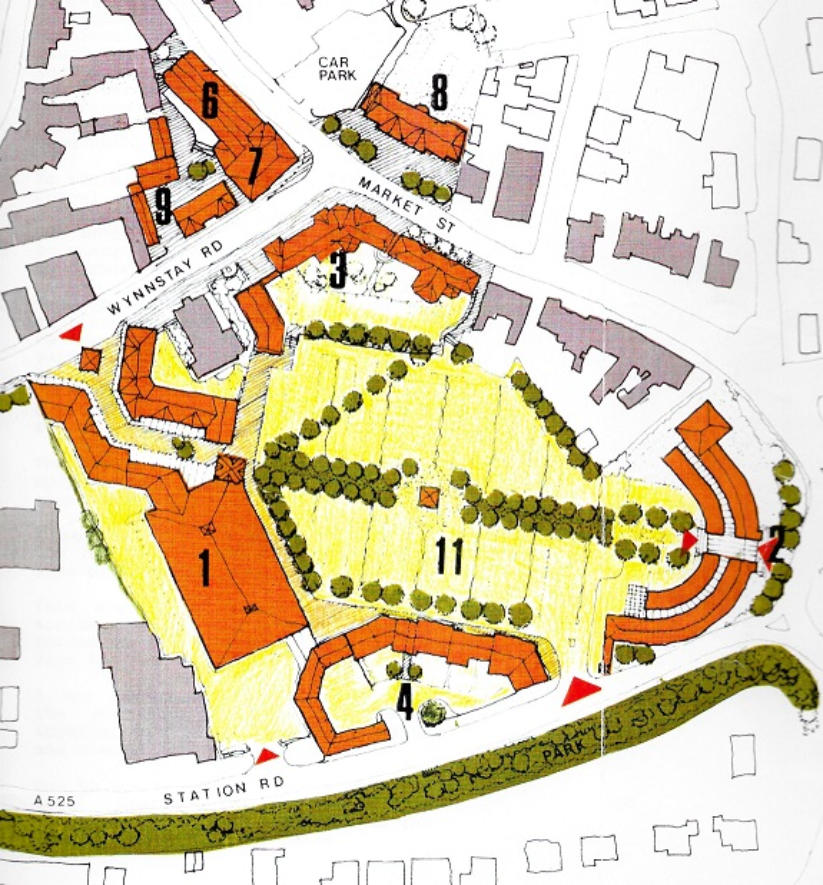
1 Supermarket and two rows of shop units leading from Wynnstay Rd. 2 New Glyndŵr offices.
3 Remodelled Clwyd offices. 4 Proposed housing. 6/7 Craft market. 8 Proposed health centre.
9 Proposed craft workshops. 11 Proposed car park

Town and Around Current Edition
Town and Around Historic Contents
Contact Us
Ruthin Local Historic Society
Copyright © 2018 Ruthin & District Civic Association


