Exemewe Hall: a Short History
It’s sad to see Barclay’s Bank closing, but it is just
another chapter in the long history of a site
where at least two previous buildings stood and
housed a home, an inn and a shop before
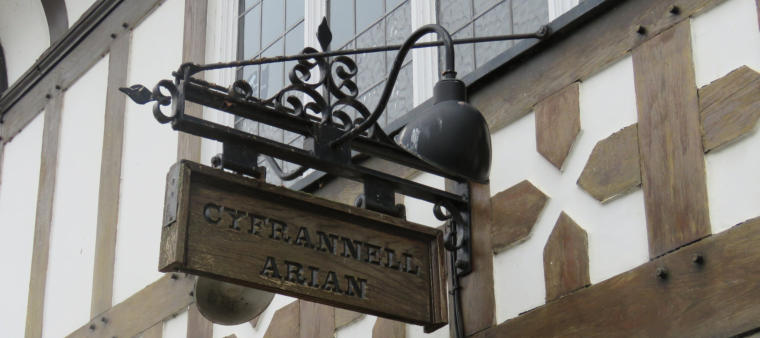
becoming a bank. It resembles a mediæval half-
timber building, but Barclay’s Bank demolished
the old Exmewe Hall in the late 1920s and
replaced it with the present copy. It has a
splendid site and the mediæval building was
built to impress and size, height and the novelty
of the construction methods were all used to
achieve this.
The Earliest Owners
The earliest identifiable owners were the
Rowells, who were followed by the Sergeants. In
1402, John le Sergeant’s daughter, Sybilla,
inherited the Exmewe Hall site. She married
Thomas Exmewe, whose family was involved in
the leather industry. No evidence has been
found for the building of Exmewe Hall, but it
was possibly built by the Exmewes, who were
wealthy and the last, Sir Thomas Exmewe,
became a leading goldsmith and Lord Mayor of
London.
The Tudor House
Sir Thomas Exmewe sold all his interests in
Ruthin to Edward ap Thomas (Goodman) in
1518/9. The Goodmans lived at Exmewe Hall
until they left Ruthin and, by 1604, were a gentry
family at Merllyn in the parish of Llanfair. The
Goodmans lived in some style. The parlour was
adorned with family portraits. Parts of the
house were wainscotted, there were cisterns to
store water and the windows were leaded and
glazed.
The house was remembered in the Goodman
family in 1671, a generation after they had left
Ruthin, as Exmewe Hall—‘Exmewe House’ only
appears in recent times.
It was probably expanded between 1548 and
1579, but the former Beehive on the south,
which survives to this day, remained in separate
ownership until the eighteenth century. In 1599,
the Goodmans bought the large property at the
rear.
Stuart and Georgian Developments
In 1675, the house was sold to Ruthin mercer,
John Price, where he ran a shop and the King’s
Arms, the classiest inn in late Stuart Ruthin. It is
likely that the building gradually became known
to all as “The King’s Arms” or “John Price’s shop”.
In 1715, Exmewe Hall held eight businesses
including an ironmonger, a mercer, a barber, a
grocer, a butcher and a smith with an inn. In
1718, Robert Myddelton bought for £300. The
King’s Arms became a house and shops in 1760.
The rear buildings stretching down Clwyd Street
as far as the Castle Bell, became the Llandegla
meat market in the mid-eighteenth century and
were replaced by
today’s mock-tudor
houses and shops
in 1878-1881.
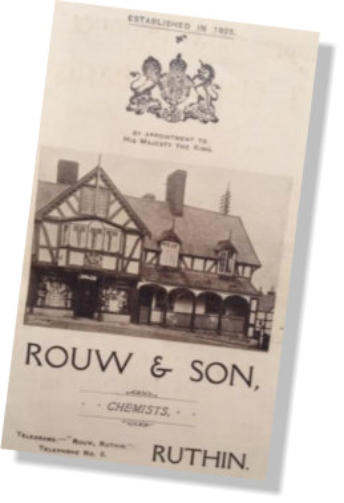
Victorian
Chemists
Throughout the
Victorian period,
chemists shared
the frontage of
Exmewe Hall with
a draper’s shop.
Around 1856,
William Rouw
became the
chemist and
provided supplies
to the gaol and the
Castle estate. He
and his son, Theodore, sold soda water and
ginger beer, essence of ginger, lead, starch,
paint, oils and turpentine. They became the
local agents for patent medicines and branded
goods, including tea. The Rouws also made
perfume using the local lavender crop sold as
“Perfume of the Vale” and “Rouw’s Lavender
Water”.
The Rouws became wealthy and influential.
William Rouw was a magistrate, and both he
and Theodore served on the borough council,
and Theodore was mayor for two years, captain
of the borough fire service, welcomed the Prince
of Wales to his shop in 1899 and received a
royal warrant.
The business continued into the 1920s when
Barclay’s Bank bought the chemist’s portion of
Exmewe Hall and demolished it and had
replaced it with the present replica by 1928.
They relocated their branch from Clwyd Street
to the Square.
Gareth Evans
March 2018

Town and Around Current Edition
Town and Around Historic Contents
Contact Us
Ruthin Local Historic Society
Copyright © 2018 Ruthin & District Civic Association


